Oracle · SCM Fusion · Agentic & ML · 2022–2026 · In production
Setup, inverted.
Configuring Oracle Fusion took deep expertise before you could even start, because somebody had to sit in the middle and translate a business need into a system capability. Usually that somebody was a paid implementation partner. So I turned the thing around. You describe the business, and the agent matches capabilities, pre-fills what it can and runs the setup, stopping only where a person genuinely has to decide. We're targeting half the implementation time.
The short version
- Legacy setup showed admins hundreds of capabilities and left them to work out which applied. That was backwards, and most of the admins we spoke to said so.
- The concepts that got there are in the case: structural wireframes, a birds-eye map of the customer’s estate, then fidelity high enough to test real approval rules.
- Ask Oracle harvests requirements, pre-fills configuration, and works through tasks with a live, auditable log.
- The design work that mattered was the autonomy model I built: act, propose, or stop and ask.
- Some of the first experiences of their kind at Oracle, and the groundwork my team laid for Agent Studio.
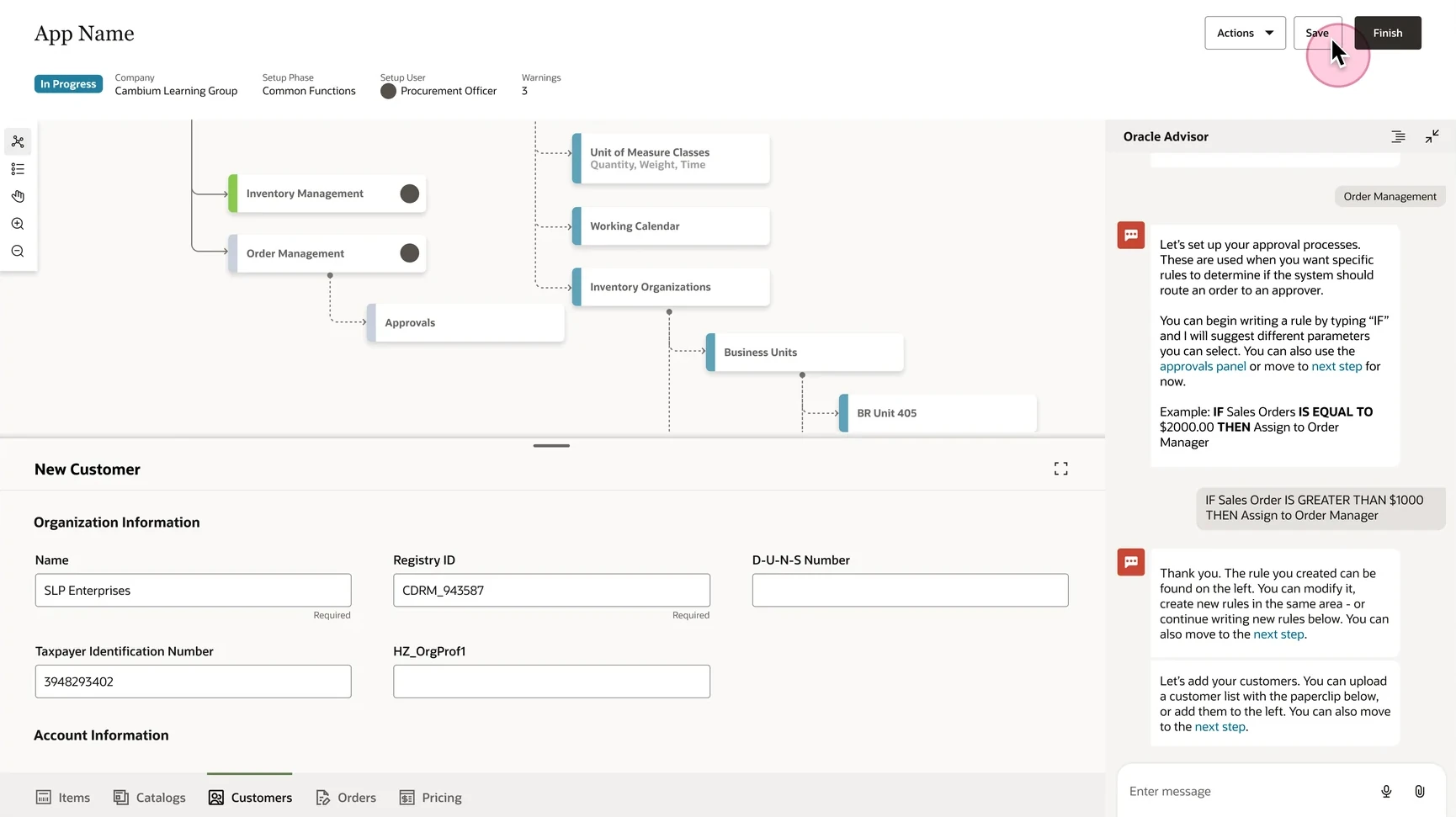
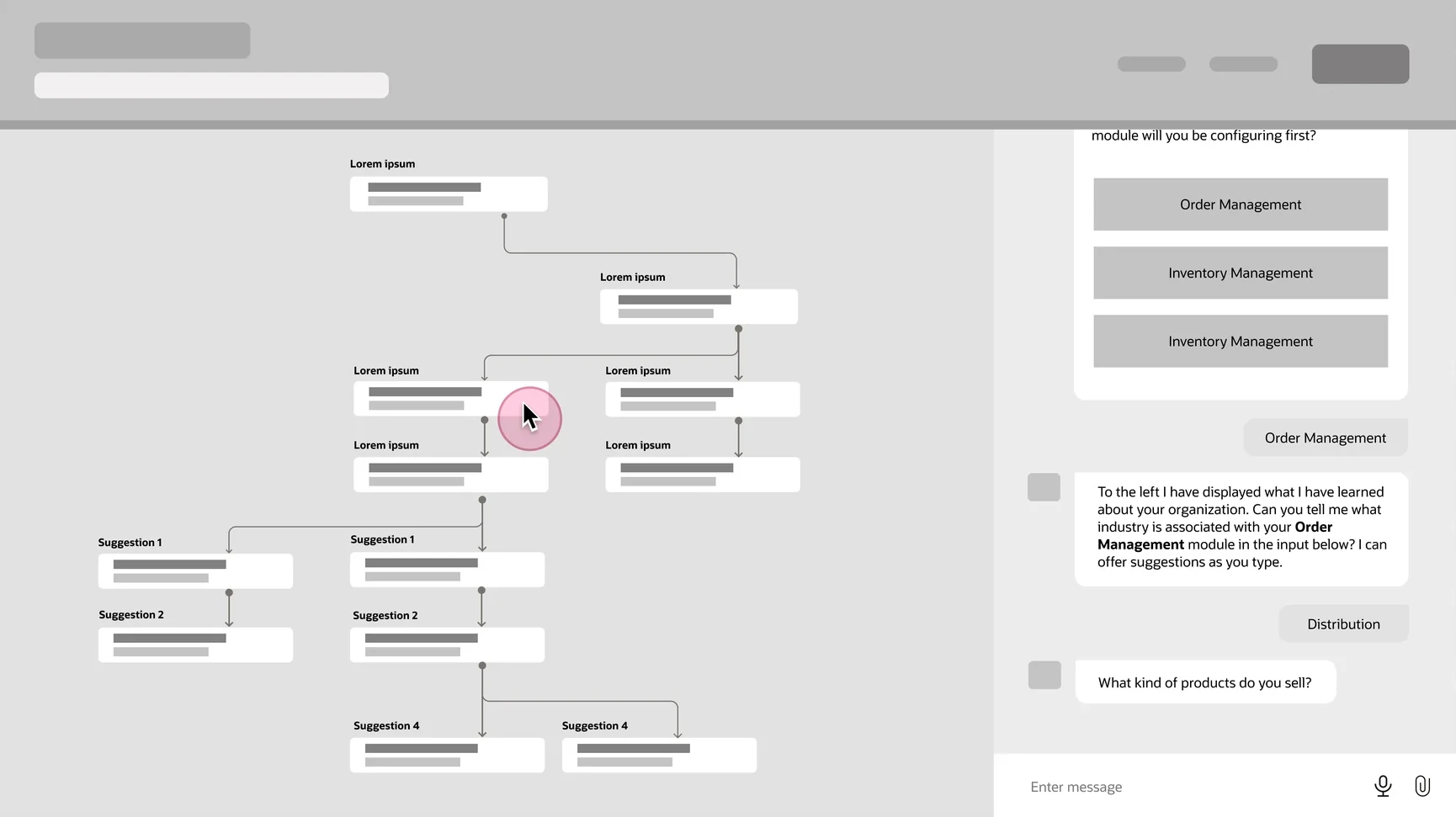
Agentic Fusion Setup: the enterprise map on the left, the conversation on the right, and the work saved back into the same place. Behind it, the birds-eye concept that changed the shape of it.
01 · The problem
Setup that demanded an expert before it could begin
Fusion setup was manual and assumed deep domain expertise: admins interpreted business requirements themselves and matched them to capabilities by hand. The Redwood migration was the moment to rethink it, not reskin it.
02 · Who sets it up
Fifteen admins, one target
03 · The journey
The Business Process Owner's setup, mapped end to end
04 · The idea
Start at the business, not the capability list
05 · The idea
Business first, system second
Describe the business process. Ask Oracle matches capabilities, pre-fills from client data and industry practice, and can run the tasks end to end, across seven functional areas and two dozen activities in the demo scenario.
None of that matters unless people trust it, and trust doesn't get earned on the happy path. It gets earned the first time the agent runs into something ambiguous and stops instead of guessing.
06 · How it got here
Being wrong in public, in order
This is the part portfolios usually delete. I didn't arrive at the design below in one go. It came out of a stack of concepts that each got one thing right and one thing badly wrong. The order matters more than any individual frame.

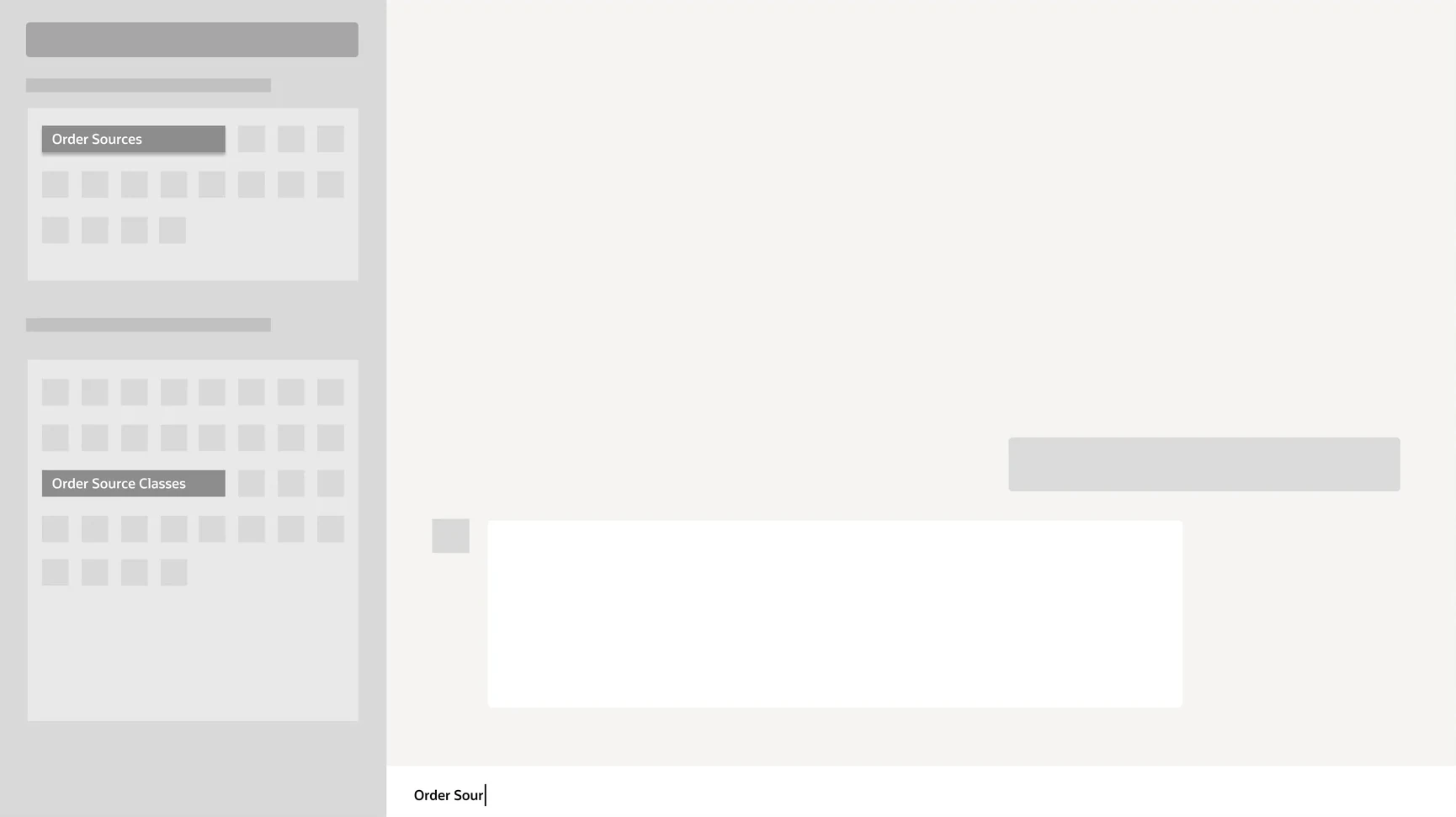
The first two structural passes. Behind, the entire configurable surface laid out as a grid so the sheer scale of it is visible instead of buried three levels into a navigation tree, with the right-hand column reserved for the agent. In front, the same structure with objects resolved inside it: Order Sources surface out of the grid in place, and the left column stops behaving like a menu and starts behaving like a map of what the agent is operating on.
The whole argument is in the ratio between the two columns. Give the agent the full width and the structure disappears. Give the structure the full width and you have the old setup screen with a chat box bolted onto it.
The concept that changed the shape of it. The conversation moves to the right and the left becomes a map, a live picture of what the agent has learned about your organization, growing as you answer.
I stopped thinking about a chat window and started thinking about a birds-eye view of somebody’s SaaS estate, with an agent as the way through it. The conversation is the input; the map is the proof it landed.
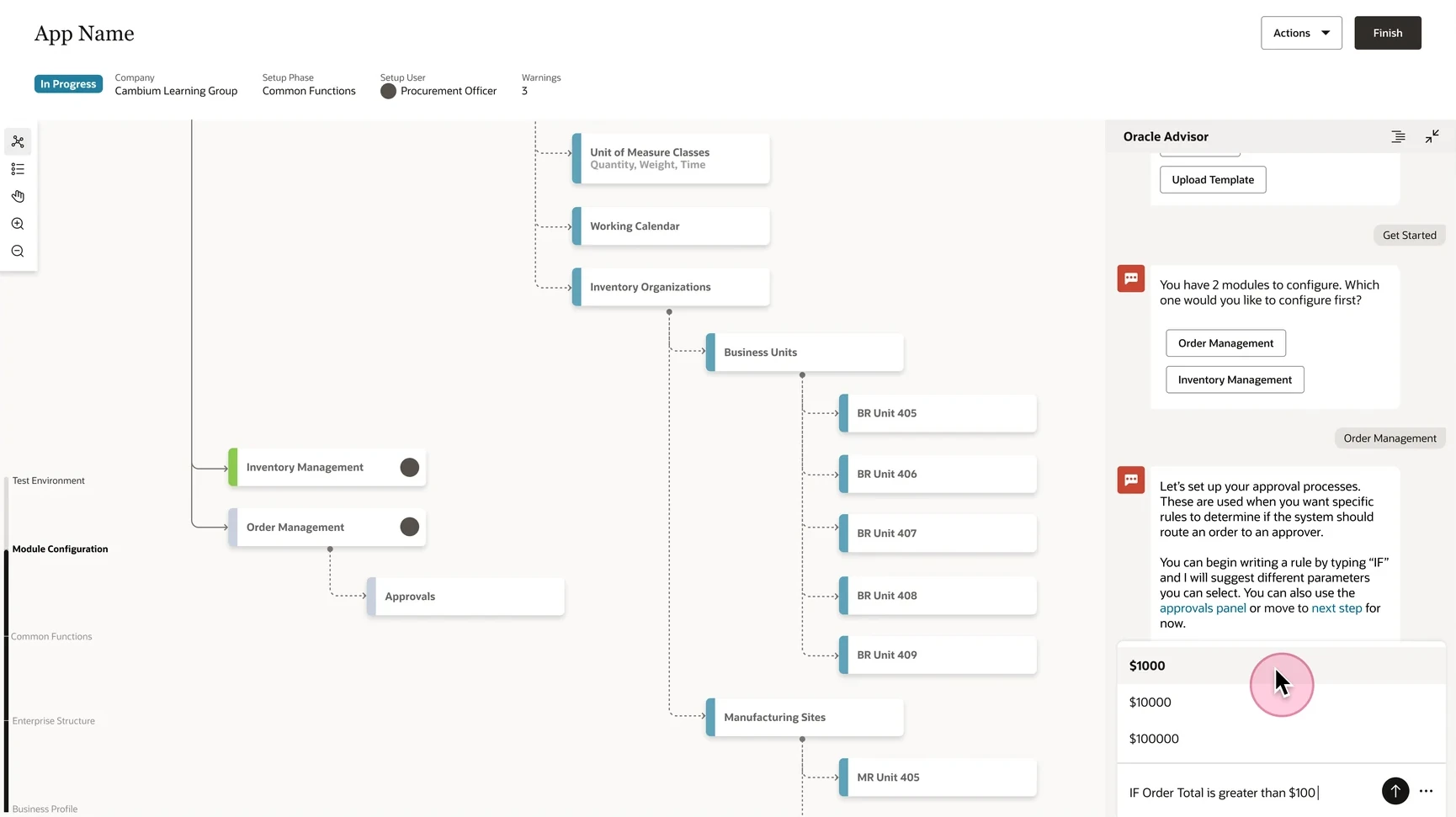
Fidelity up, and two real task shapes. Writing an approval rule by typing “IF” and having the agent suggest the parameters, with the enterprise structure the answers are assembling behind it. Then a full customer record open beneath the map, the conversation still running alongside, and the work saved back into the same place.
Testing at this fidelity is when the autonomy question stopped being theoretical. The agent suggesting a threshold and the agent setting one are different products. And getting the map, the conversation and the form to coexist without any of them taking over took more iterations than anything else in the project.
07 · The core of it
The autonomy model
Three scenarios, and almost all of the design work lives in the seams between them rather than in the states themselves. The third one is what makes the other two sellable. The enterprise buyers I've sat across from worry far more about what the agent will do when it shouldn't than about what it can do.
Pattern spec · AGT-01
In production · Fusion
Each state carries its own evidence contract and its own audit rule.
Act
High certainty
- When
- Inputs are unambiguous and one action is defensible.
- Agent
- Completes the task on its own, streaming a work log, every action with its data source.
- Human
- Watches the log, and can interrupt at any step.
- Audit records
- The action, attributed to the agent, with evidence attached.
Propose
Valid alternatives
- When
- More than one path is valid.
- Agent
- Recommends one option with its evidence, and keeps the alternatives in view.
- Human
- Confirms in one tap, or picks another path.
- Audit records
- The decision, attributed to the person who confirmed it.
Stop & ask
Missing or conflicting data
- When
- Required data is missing, or two sources conflict.
- Agent
- Halts, names what it needs, and surfaces candidate answers with its analysis.
- Human
- Supplies the answer, and the work resumes from that point.
- Audit records
- The input, attributed to the person who supplied it.
The audit trail names a person at every step. The model started on Fusion Setup, other Fusion teams reuse it, and it's encoded as Codex skills.
08 · Transparency
What the agent shows while it works
Autonomy without visibility is a black box with better manners. So every run streams a work log: the sub-step, the data source behind it (an HDL file, an HR profile), and the outcome. An admin can watch it happen, and afterwards, the same log is the audit trail.
It also means a paused run explains itself in place. The agent stops, and then it shows the two candidate answers, what it checked, and which one it would pick.
09 · The research behind it
Setup is one stop on a longer road
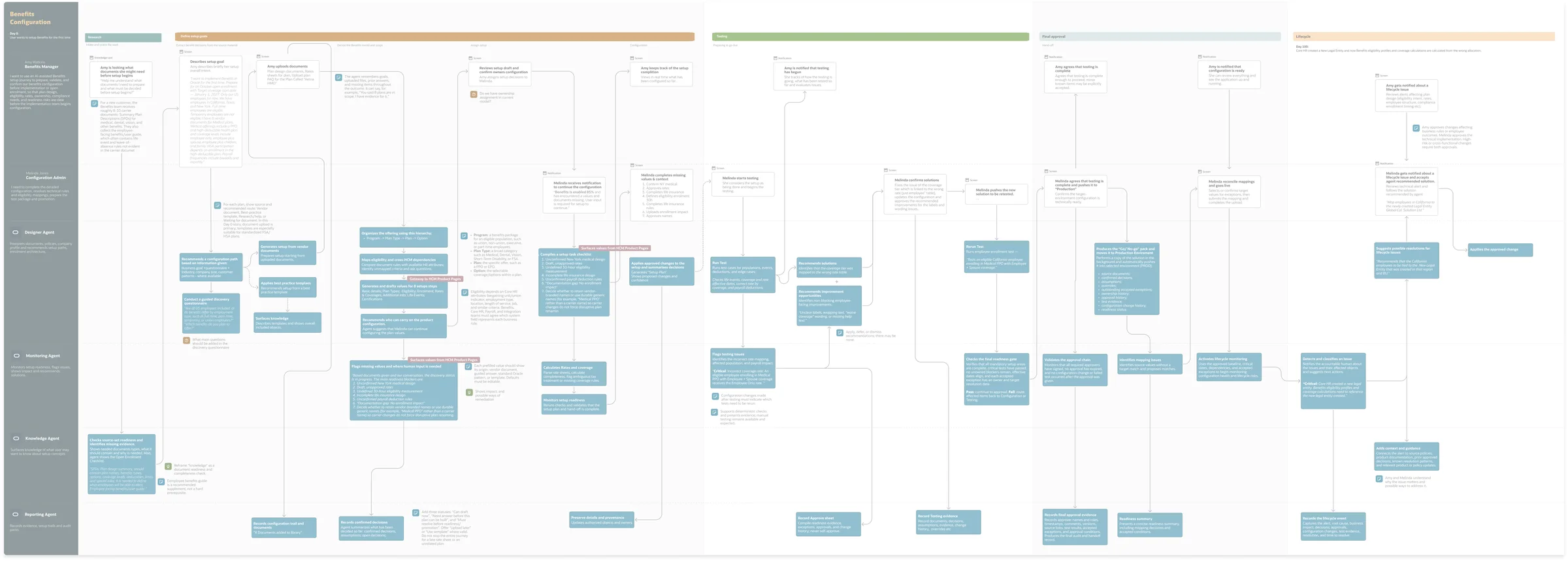
The benefits journey I mapped from first setup through to lifecycle, the artifact that showed setup was never the destination, only the first gate.
Mapping past the launch is what made the case for taking the pattern beyond setup.
10 · The run
Payroll Configuration, start to finish
Everything above is a model. This is one functional area going through it end to end: Payroll Configuration in a test environment, set up by the agent while an administrator watches. It matters that it's an unbroken sequence rather than a highlight reel, because the argument the whole case makes lives in what happens between the first screen and the last. Watch what it does on its own. Then watch the one moment it refuses to.
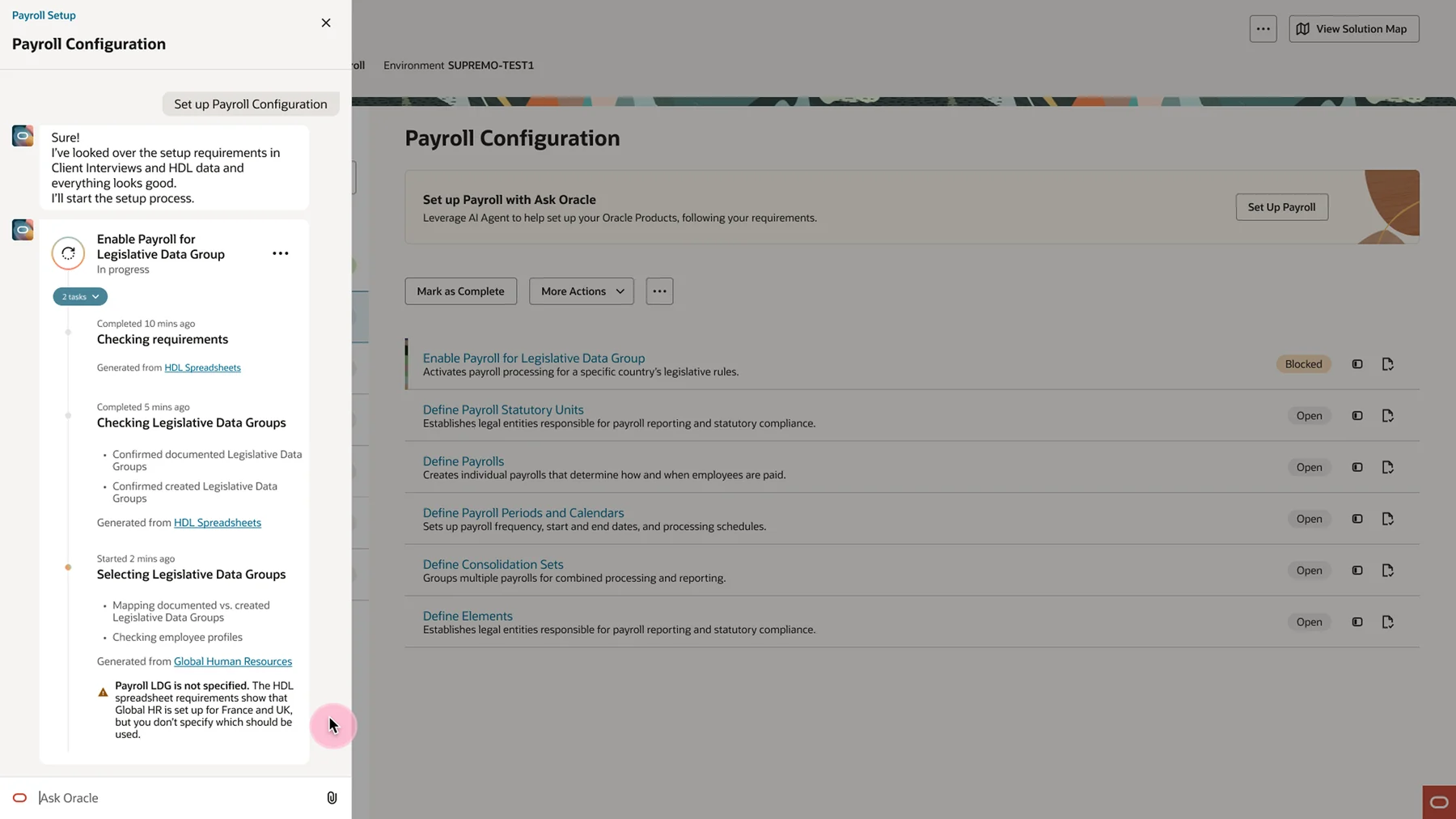
The entire ask is four words. The agent answers by naming what it read: the client interviews and the HDL spreadsheets, and then starts working, streaming each sub-step with the source that produced it. Two steps in it already knows something is wrong: the Legislative Data Group was never specified, so the task on the right goes Blocked before a person has said a word.
Every line in the log names the source that produced it. That's what turns a progress readout into something an auditor can read six months later.
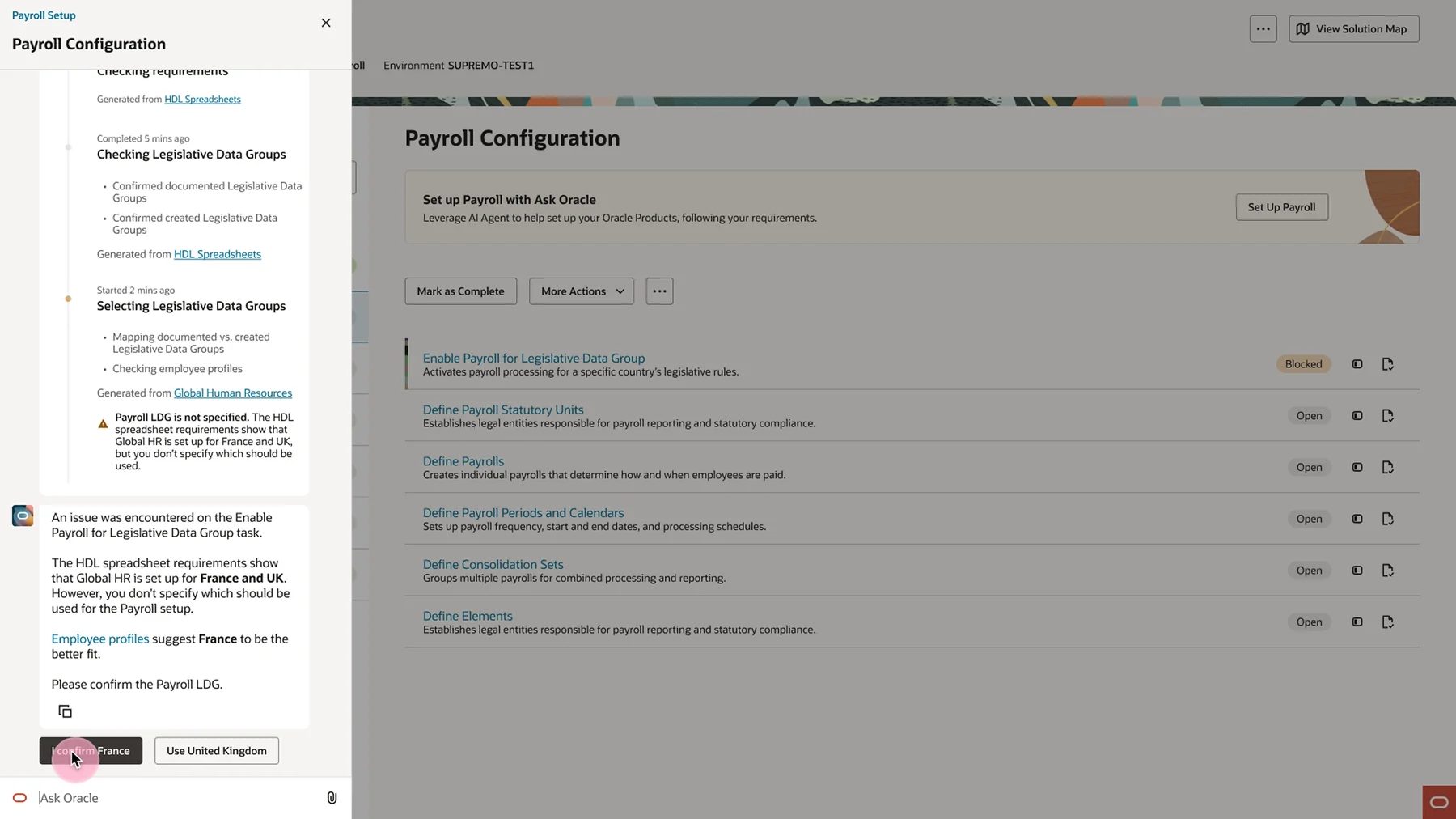
This is the stop-and-ask state from the autonomy model, in the flesh. It reports the failure and then says what it found (Global HR is configured for France and the UK), what it checked next, which of the two it would pick, and then it hands the decision over with both options still on the table.
It has an opinion and it stops anyway. Which is the behavior I spent most of this project defending, because it's the difference between an agent people will run unsupervised and one they won't.
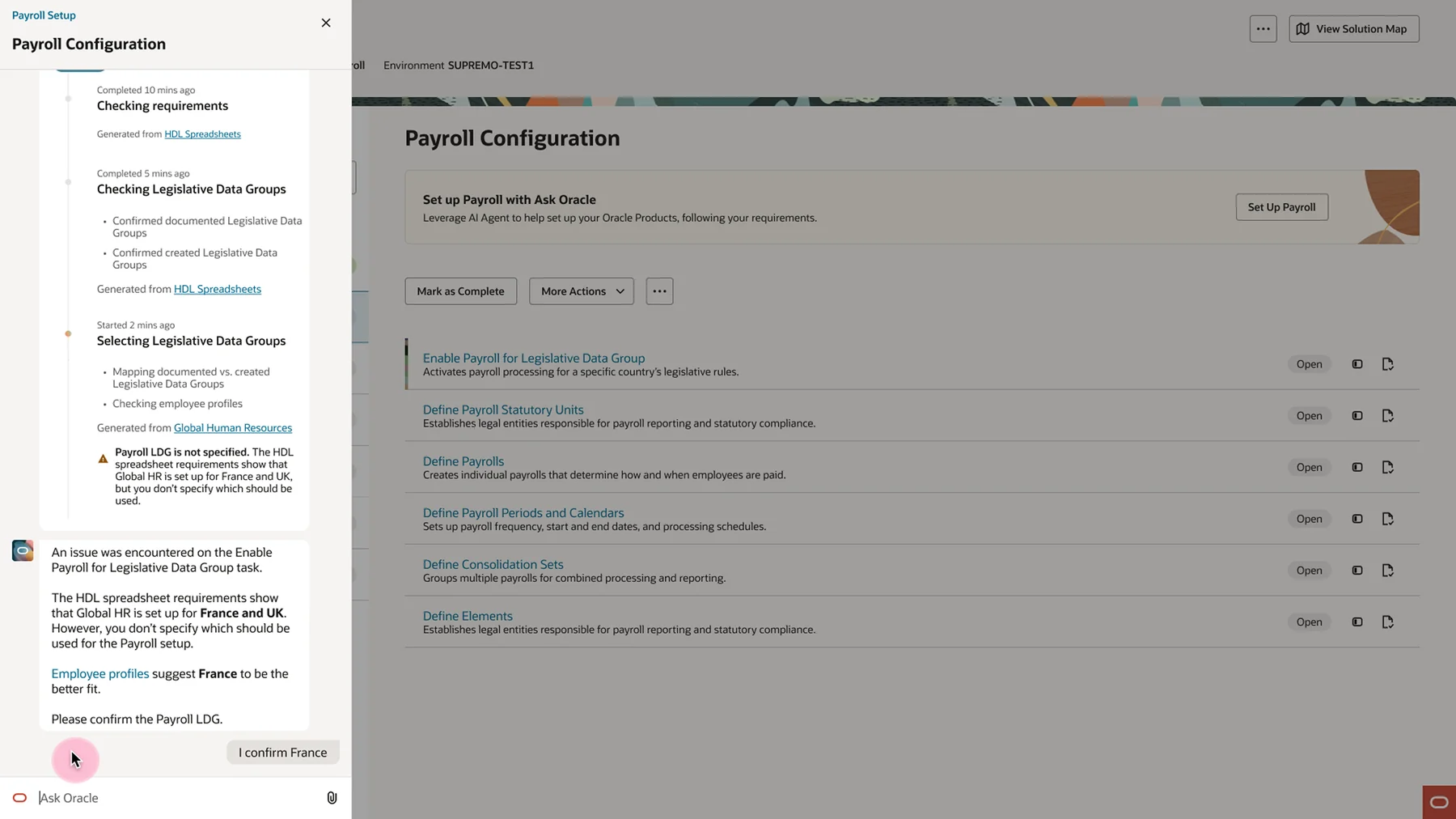
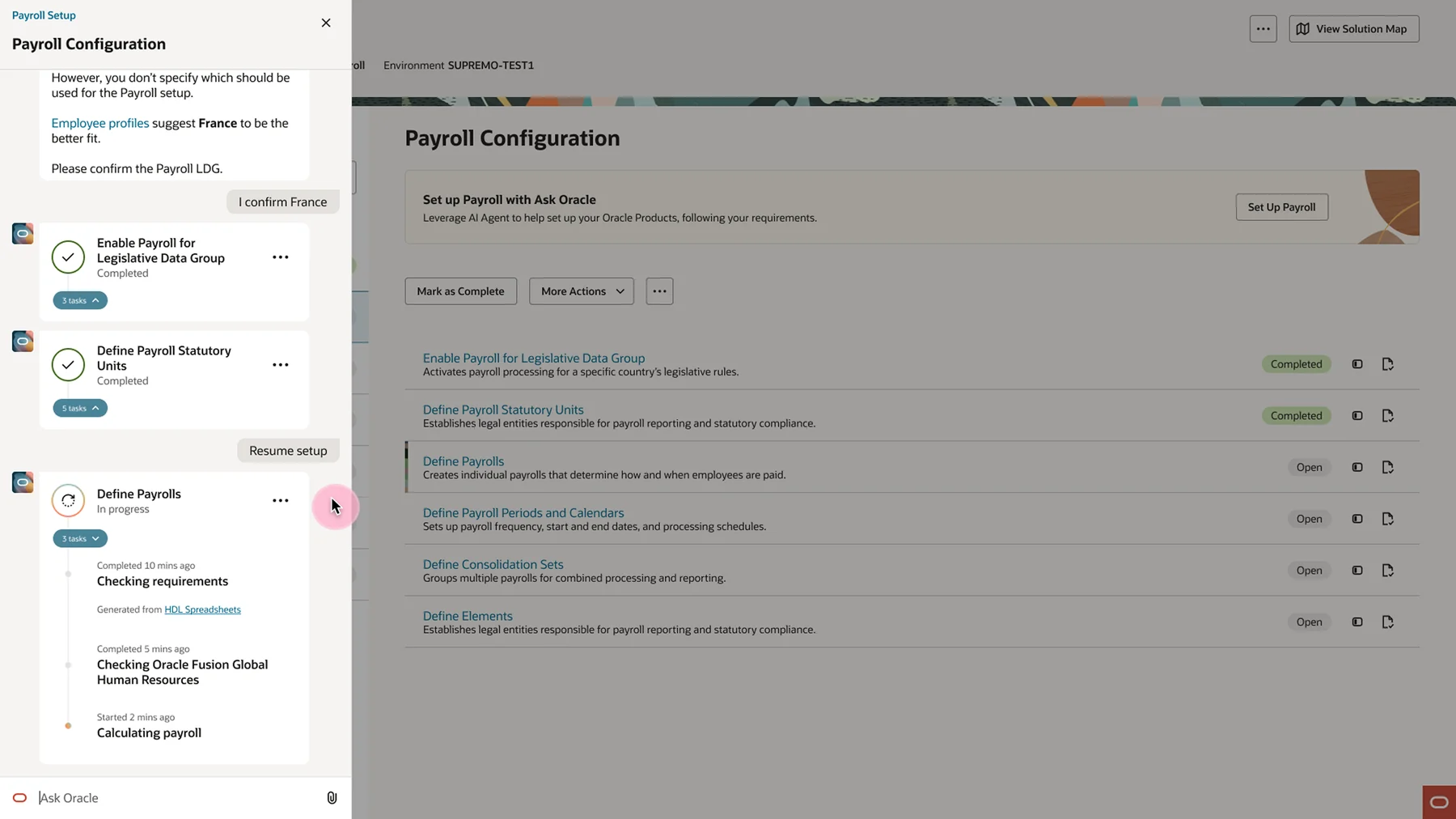
One click, and the answer lands in the transcript as something the administrator said rather than something the system inferred; the blocked task turns over to Open. Unblocked, it carries on down the list by itself, Enable Payroll, then the statutory units, then the payrolls themselves, and every finished task collapses into a card that can be opened back up. “Resume setup” is the administrator picking it back up, not the agent asking for permission again.
Six months later, “who chose France” has an answer with a name attached to it. And if a person can't stop the run and pick it back up on their own schedule, what they have is a batch job with a conversation bolted onto the front of it.
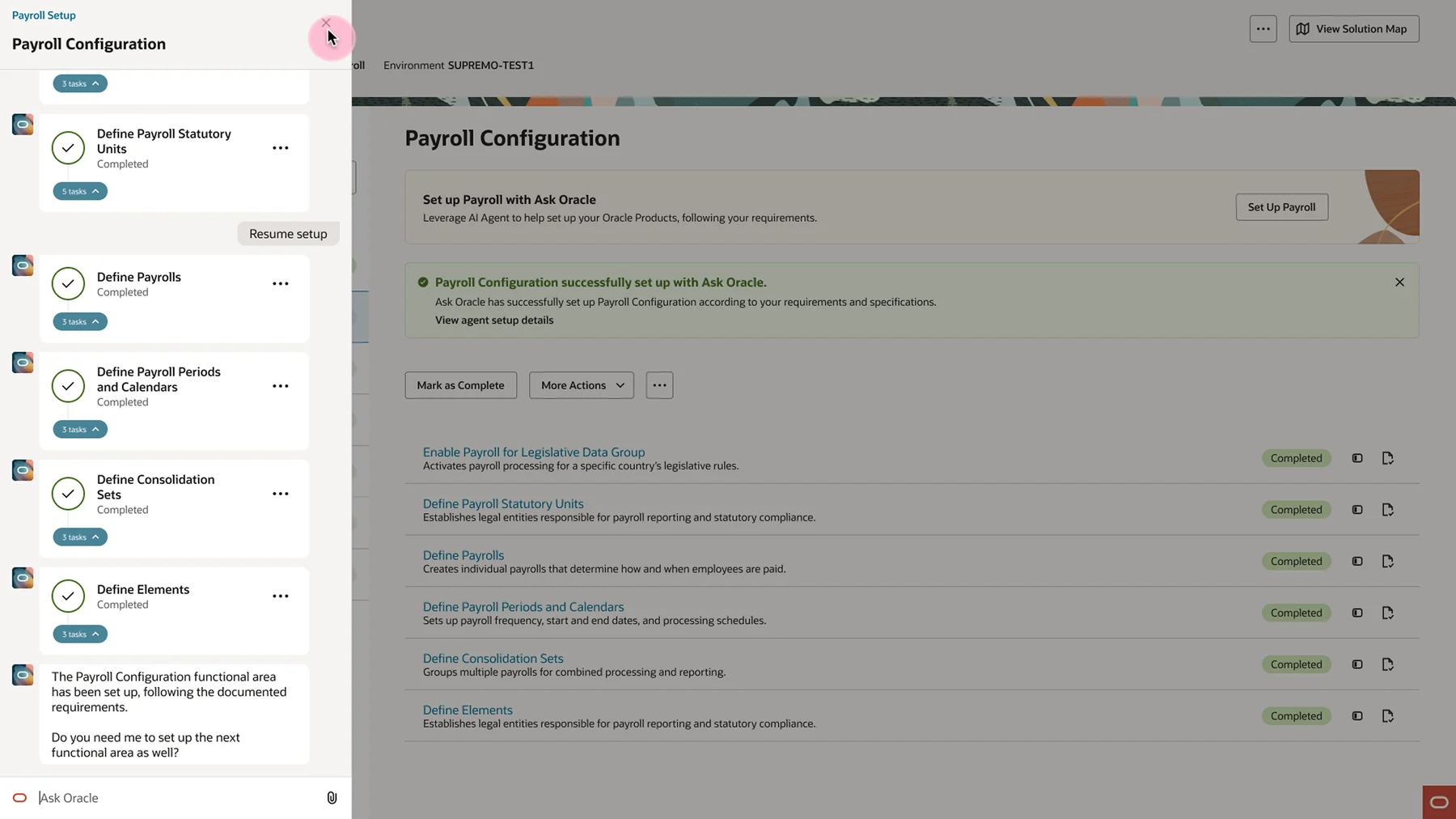
Six tasks, all Completed, and a banner that links back to the setup details instead of replacing them. Then the part I like most: it asks whether to take on the next functional area, and it waits for the answer.
It ends the way it opened. The agent proposes and a person decides, including about the work that comes next.
11 · Where it went
The panel, further along
The run above is setup. This is the conversational panel after the pattern had been through several more functional areas: the same three states and the same work log, with the panel now the front door to all of it. The reasoning and the sources sit one tap away instead of streaming by default, which turned out to be what people wanted once the novelty wore off.
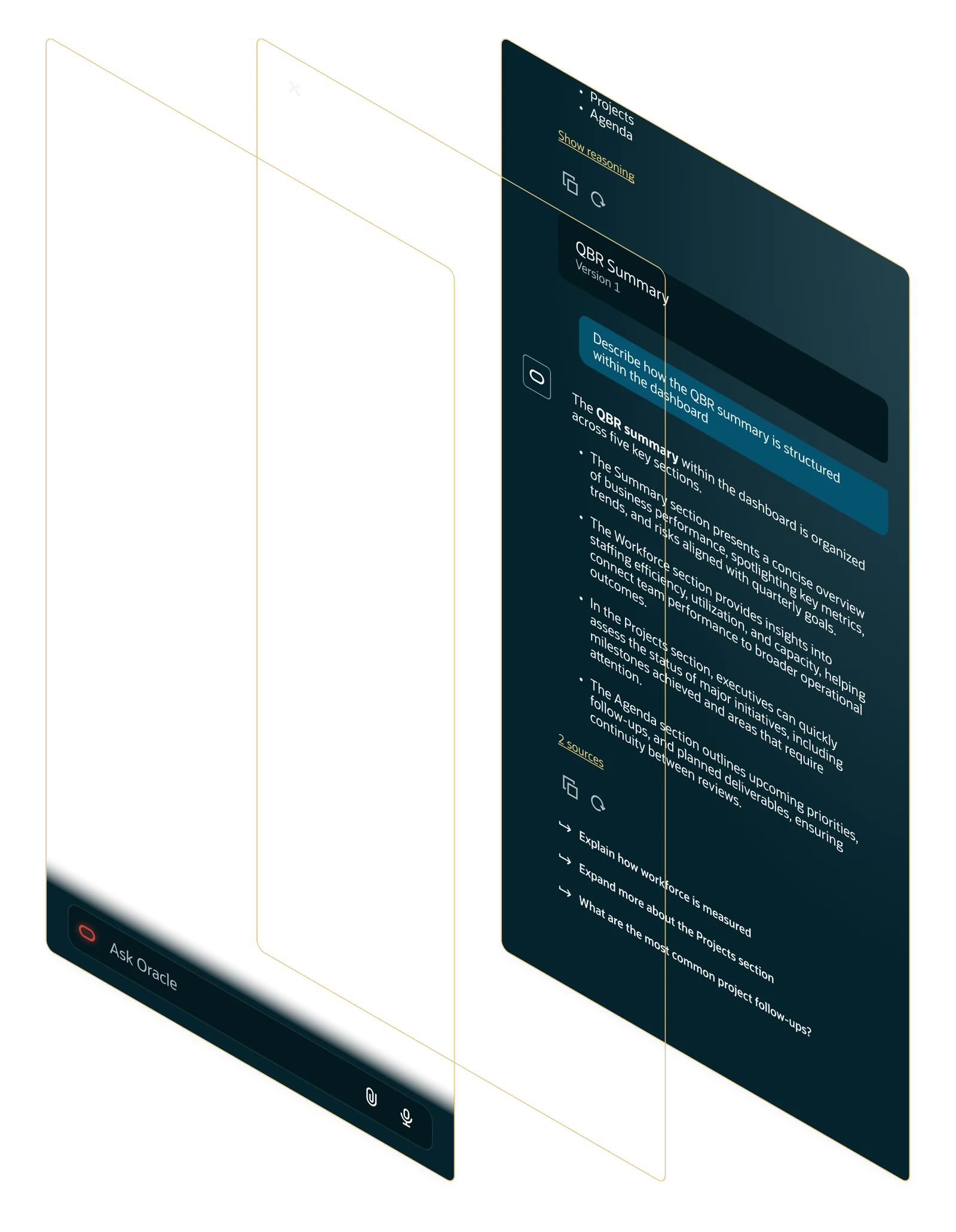
The panel pulled apart into its three layers: the Ask Oracle bar with attach and voice, the container that slides in over the page, and the conversation itself. Keeping them separate is what lets the same panel front any Fusion area without the conversation needing to know what sits underneath it.
The bar is the only piece that's always on screen. Everything else arrives when somebody asks for it.
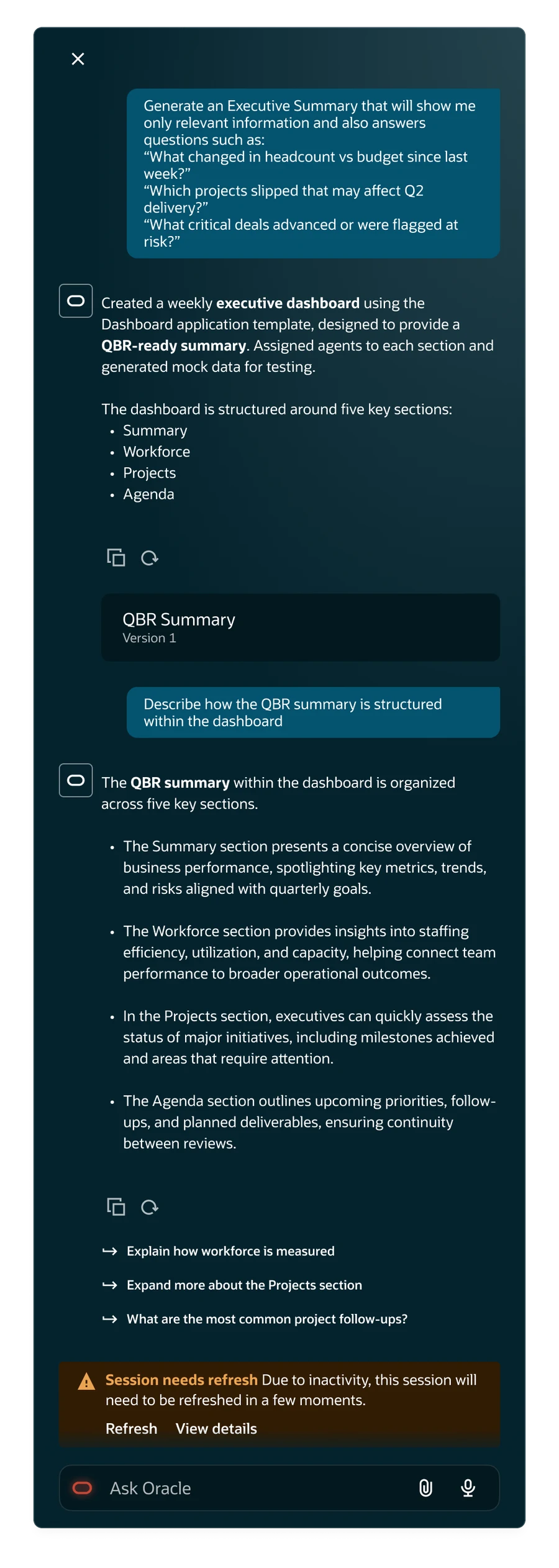
A full exchange. The person asks for an executive summary that can answer three specific questions. The agent builds a weekly dashboard from the application template, assigns an agent to each section, and hands back a QBR Summary as a versioned artifact. The follow-up answer carries a sources link and a show-reasoning link, which is the work log from earlier in this case, folded away until it's wanted.
Two details I'd defend in a review. The artifact is versioned, so a second attempt doesn't overwrite the first. And the session notice says what is about to happen and why, rather than logging the person out mid-thought.
12 · What it became
The pattern outgrew setup
Setup was the problem that produced the model, but nothing in the model was about setup. Describe an outcome in business terms, let the agent do the assembly, and hold a hard line on what it may finish versus what it must bring back. That shape applies anywhere a Fusion user knows what they want and not which twelve objects produce it.
So it generalised. The same prompt surface, the same autonomy modes, and the same work log went on to front other functional areas, with every run landing somewhere it can be reopened and audited. That spread is the part I'm proudest of, and the part that took the most alignment: a pattern only becomes a standard when other teams choose it without being told to.
13 · Standards as code
The pattern is what ships
System diagram · DS-01
Standards as code
A pattern in Figma is a suggestion. A pattern in the pipeline is a decision already made. The route from one to the other, as built for the Codex skills library.
-
01 · Pattern
A behavioral commitment
Not a button and a modal, the rules underneath: when to act alone, what evidence streams, how a refusal sounds, where the human decision lands.
-
02 · Skill
Encoded once, executable
- pattern
- propose-confirm
- streams
- work-log + sources
- confirm
- one tap, named human
- refuses
- averaging red grades
Written down once as a Codex skill, instead of re-taught in every review.
-
03 · Prototype
Accurate by construction
Anything built from the library uses the real components, real autonomy rules, real evidence format, before an engineering estimate exists.
-
04 · Product
Correct by default
The compliant pattern is what every team gets without asking. Deviating takes deliberate effort, which is the right way around.
The loop back: watch patterns in the wild for reuse, overrides and drift. A pattern that stops earning its place gets redesigned or retired the same way it shipped, through the library, once, for everyone.
The target
50%less setup time
Validated in a vision demo approved by executive stakeholders and a cross-functional team of 20+.
14 · Reflections
What it surfaced
- Starting from the business process held up: admins stopped needing domain expertise to begin.
- Executives approved my vision demo, which locked the direction.
- Pre-fill collapsed hours of manual research into a starting point admins can review.
- I ran RITE testing during Concept and caught navigation and terminology problems while they were cheap to fix.