Can this BOM reach Green
before the gate?
Design-freeze reviews are where hardware programs slip. Five risk dimensions, hundreds of documents, and a verdict that in practice belongs to whoever spoke last in the meeting. For Fusion Claw, which is Oracle's deep-research agent, I designed the bill-of-materials review as one governed question with an answer somebody can argue with.
Overall grade
D
Grading scope
35 descendants
Confirmed blockers
2
Release decision
Blocked
The short version
- The gate decision was tribal knowledge over a spreadsheet. The people in the room could say whether a BOM felt ready, and not why.
- So I made it one ask. Claw grades five dimensions, names the blockers, and shows the document behind every claim.
- RACK-900 comes back a D, Blocked: two cable records out of 35 descendants break a no-waiver material limit. Claw models three recovery paths, backs the one that survives, and the gate moves a week earlier.
- The one rule I wouldn't trade away: the gate gets signed by a person with a name, never by the agent.
The brief
Is this BOM Green, Amber, or Red, why, and what has to happen next?
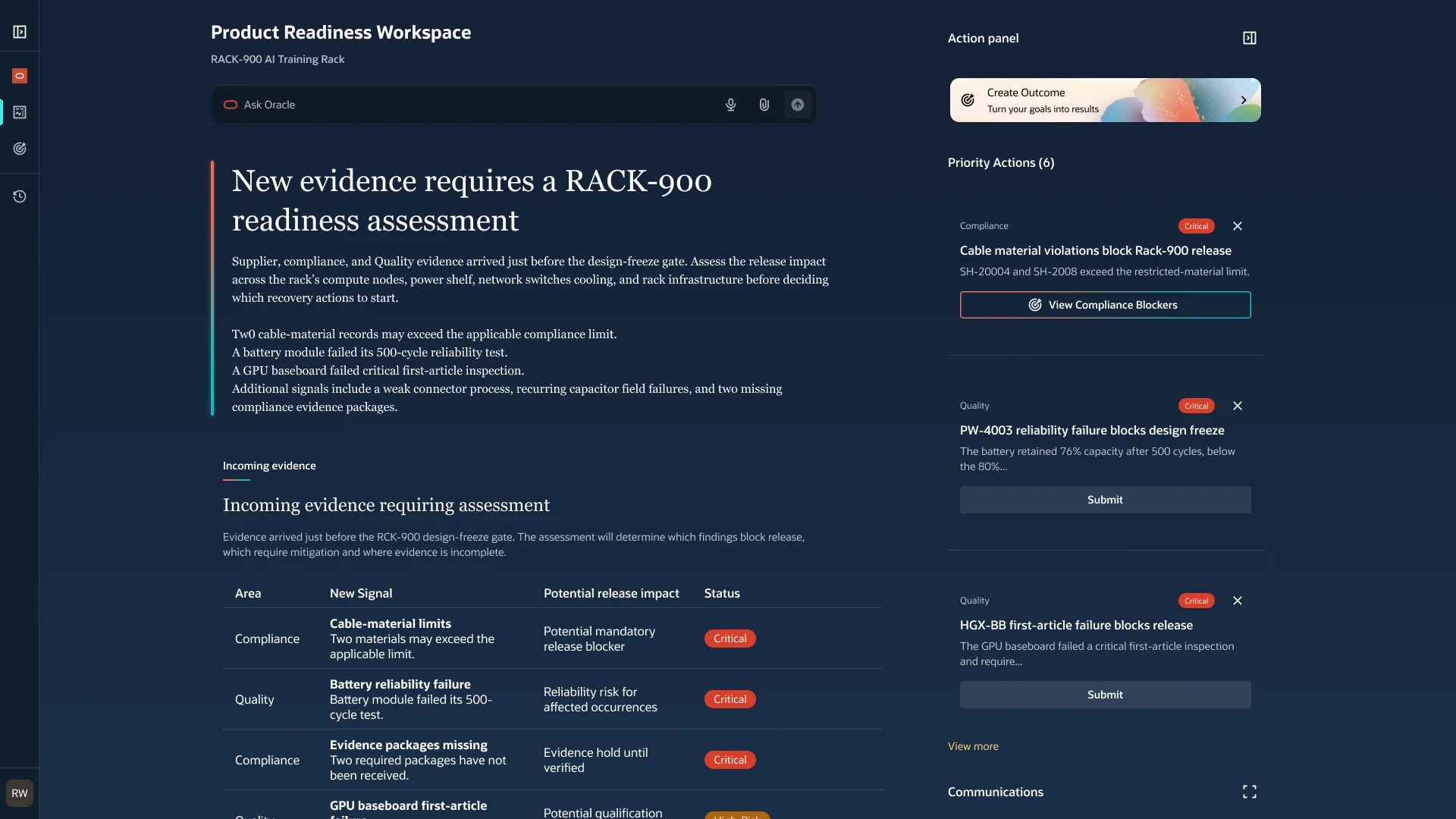
The Product Readiness Workspace. Priority actions ranked, incoming evidence queued for assessment, and the signals that still need a person.
The first thing on screen is what needs deciding today, rather than everything the system happens to know.
01 · The problem
A verdict that lived in somebody's head
A design freeze asks one question of a bill of materials, and answering it honestly means walking 35 descendants across lifecycle, sourcing, quality, cost, and compliance. Supplier declarations. EOL notices. RFQ coverage. Policy thresholds. In practice the review was a meeting, the meeting ran on the most confident voice in the room, and the evidence sat in ten systems nobody opened while it was happening.
In my experience programs rarely slip because the data is missing. They slip because the people in the meeting can't pull it together fast enough to argue with, so they decide on feel instead. That's a decision problem more than a data problem, which is what made it worth designing rather than reporting on.
02 · The platform
What Fusion Claw is
Oracle has spent the last two years turning Fusion from software that records work into software that does it. Agent Studio, an agent marketplace, more than a thousand agents running inside ERP, HCM, SCM and CX. Claw is the deep-research end of that shelf. You hand it a question that would cost an analyst two days, and it goes and reads everything.
The detail that changed my design: it runs inside Fusion, not beside it. Same identity, same row-level security, same approval routing, same audit trail, so Claw already knows who is asking, what they're cleared to see, and whose name goes on the release. I never had to design permissions. I had to design a research run that behaves like it knows it's being audited.
That's a better starting position than most agent work gets. Usually you spend the first year earning permission to touch anything. Here the permission arrived on day one, which meant the only real risk left was designing something that spent it carelessly.
03 · The stack
Four layers, one of them mine
04 · The model
Five dimensions, one verdict
Each dimension is graded on its own evidence and traces back to it. One Red is enough to stop a release, which is the behavior the gate needs.
| Dimension | What it weighs | RACK-900 |
|---|---|---|
| Lifecycle | PCN and EOL notices, component continuity | A |
| Sourcing | Single-source exposure, approved suppliers, RFQ coverage | A |
| Quality | Qualification status, open defects, evidence of test | B |
| Cost | Roll-up cost, variance, replacement economics | A |
| Compliance | Supplier declarations, policy rules, governed exceptions | D |
05 · The reframe
One outcome, not forty tabs
There's no screen to find the answer on. You ask for it. “Evaluate BOM readiness for RACK-900” starts a research run: Claw pulls the current revision, expands the structure, grades the five dimensions against gate policy, and rolls the result into Green, Amber, or Red with the reasoning attached.
In the scenario above, 33 of RACK-900's 35 descendants are clean, and the release is still Blocked, because two cable records exceed a material threshold R-CMP-05 permits no waiver for. A single weighted number would have rounded two fatal records into a passing grade, so the readout refuses to produce one: the grade, the decision, and the two records that drive it sit side by side.
06 · The product
From ask to verdict
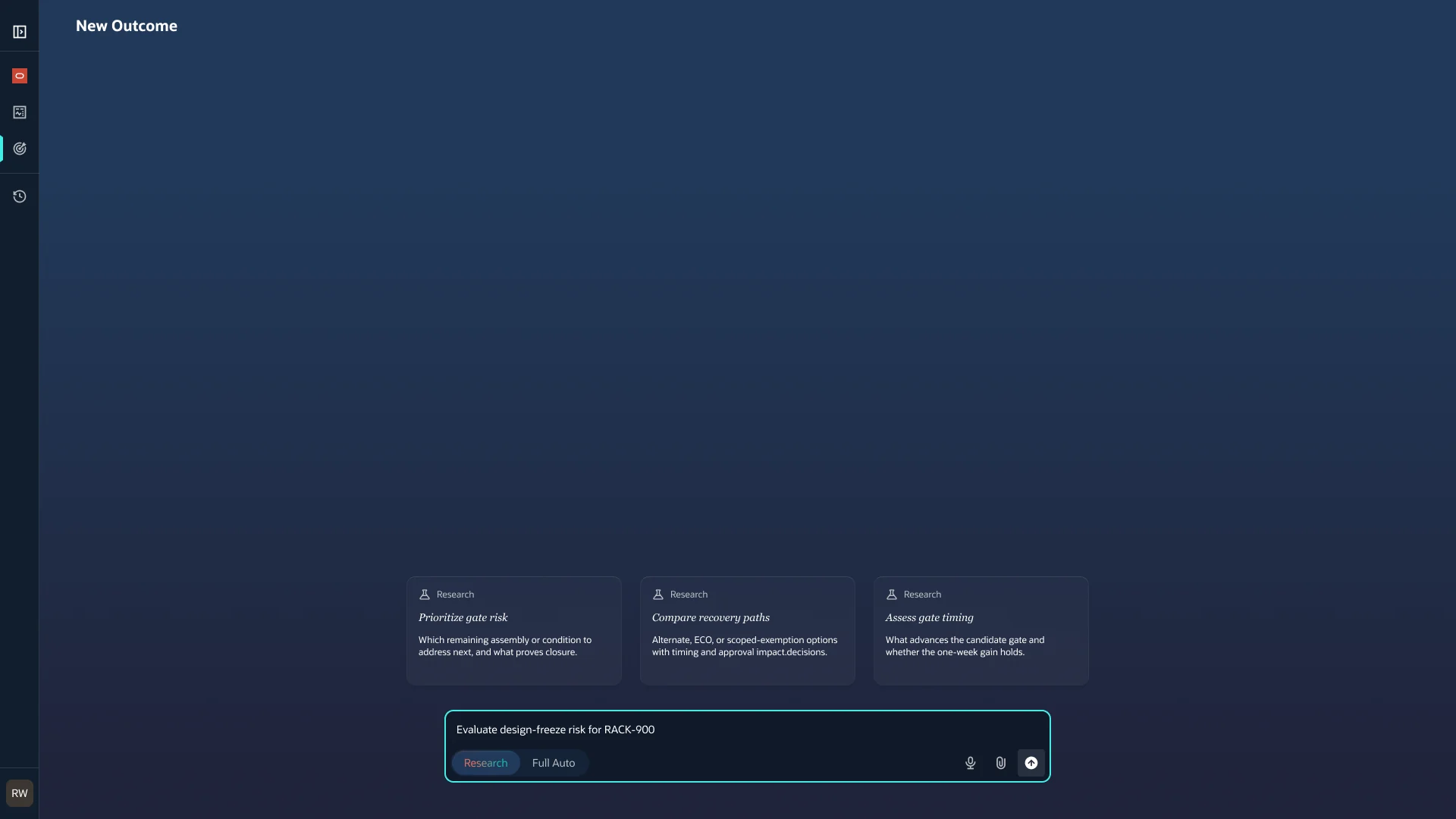
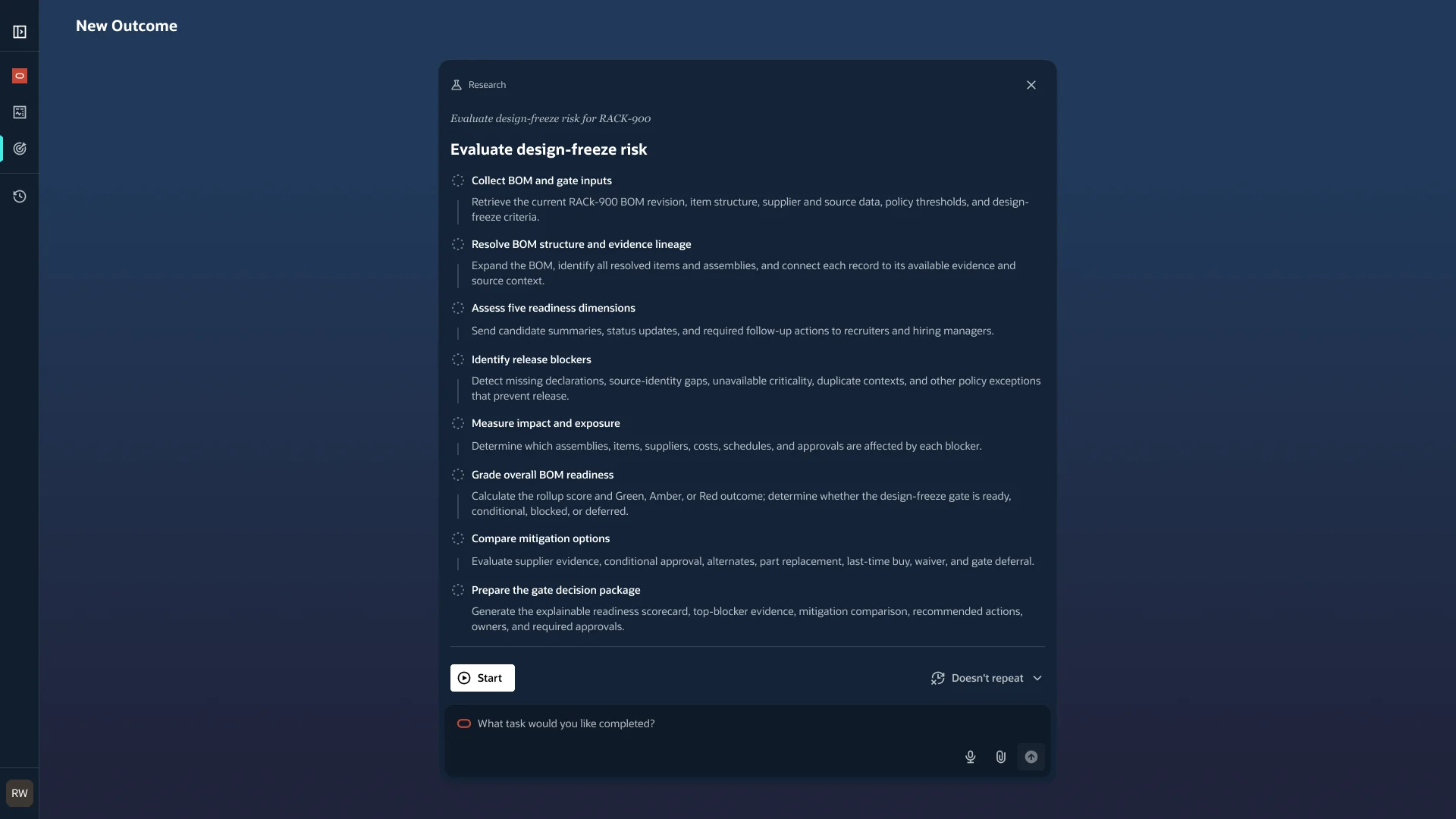
The whole setup is one sentence, evaluate design-freeze risk for RACK-900, with Research or Full Auto as the only dial. Beside it, the outcome composer: every step Claw intends to take, laid out for review before the run starts.
You get to read the plan before it runs, which is the cheapest place to catch a research run that has misunderstood the question.
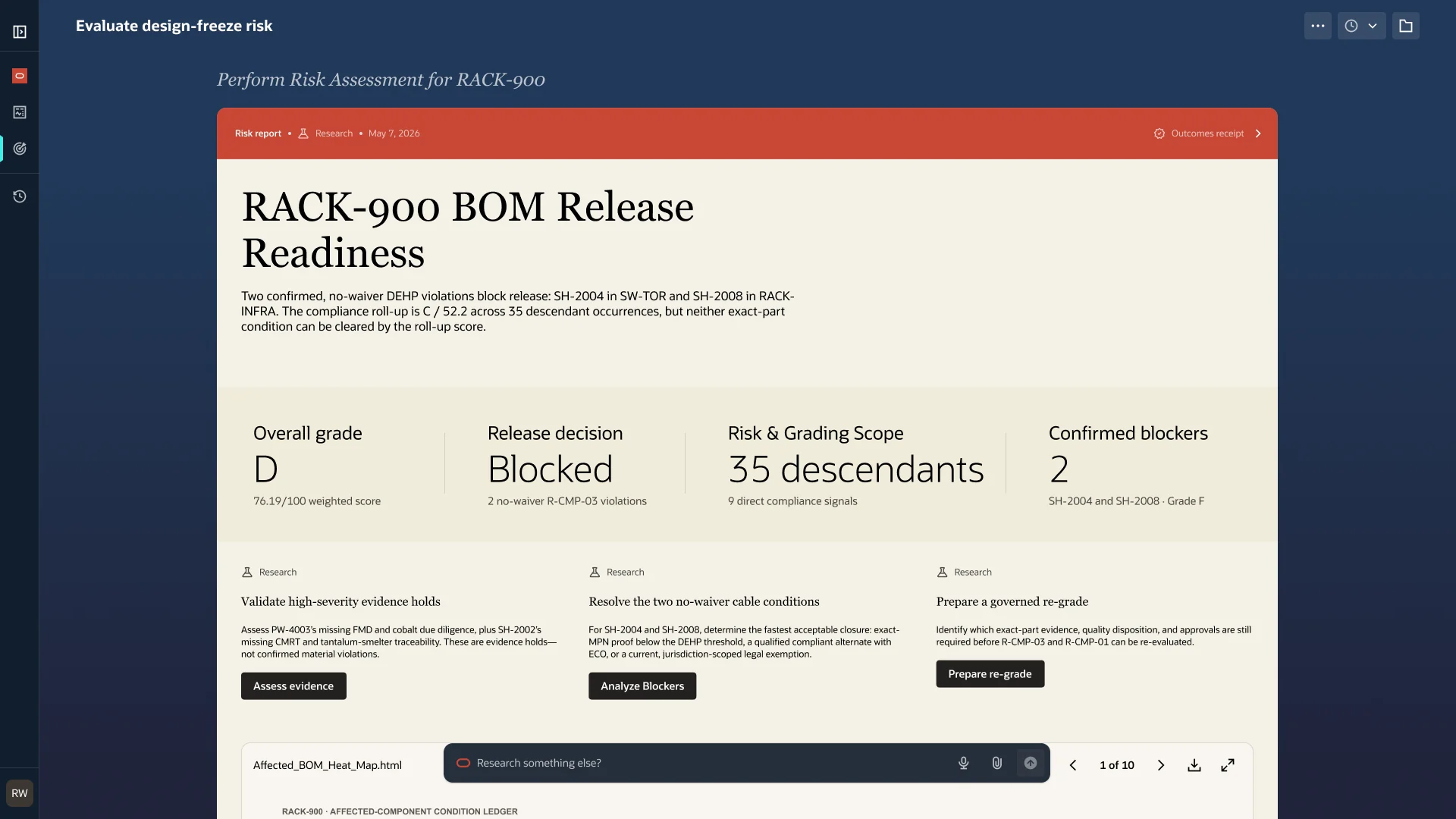
Grade D. Release Blocked. 35 descendants, two confirmed blockers, and the report names which two.
There's deliberately no single score. The grade and the release decision sit next to each other, and each one carries its own evidence.
07 · Traceability
Every number walks back to a document
Pattern spec · AGT-03
Traceability
The anatomy of a single agent claim. Every part exists so a person in a gate meeting can challenge it, and reach the record that settles the argument.
Sourcing is exposed on the cable assembly. Single-sourced; supplier under a stop-ship notice.
Red · blocker
Evidence
- supplier-notice.pdf · p.2
- sourcing-record · row 214
- checked 07:41 today
Why this grade? Opens the full chain, claim to source document.
Decision belongs to the gate owner: the agent researched this; it doesn't approve it.
-
1
The claim.
One sentence, specific enough to be wrong.
-
2
The grade.
Red never averages into a passing score. A weighted number is how fatal issues hide.
-
3
The evidence.
The records that say so, with their freshness, not a summary of them.
-
4
The chain.
Every “why?” resolves to a source a person can open mid-meeting.
-
5
The owner.
A named human role holds the decision. The agent researches everything and approves nothing.
Illustrative content · pattern, not product UI.
08 · Design decisions
Three choices that shaped it
-
01
Evidence-first drill-down
A Red opens the full record: the policy rule, the two affected records, the observed values against the limit, the attachments, the approval trail. There's no banner that says “issues found.”
-
02
The report lives inside the outcome
Grading and blockers render in an embedded viewer with its own pagination. Ten pages of report without leaving the tab.
-
03
Mitigation is a comparison, not an escalation
Eight paths: request evidence, qualify an alternate, replace the part, last-time buy, waiver, defer the gate, with compliance, cost, schedule, and owner on each. Some don't clear the risk. They stay on the table anyway, because sometimes the schedule wins and the team needs to see what that costs.
09 · Getting to Green
Evidence, mitigation, and a governed path
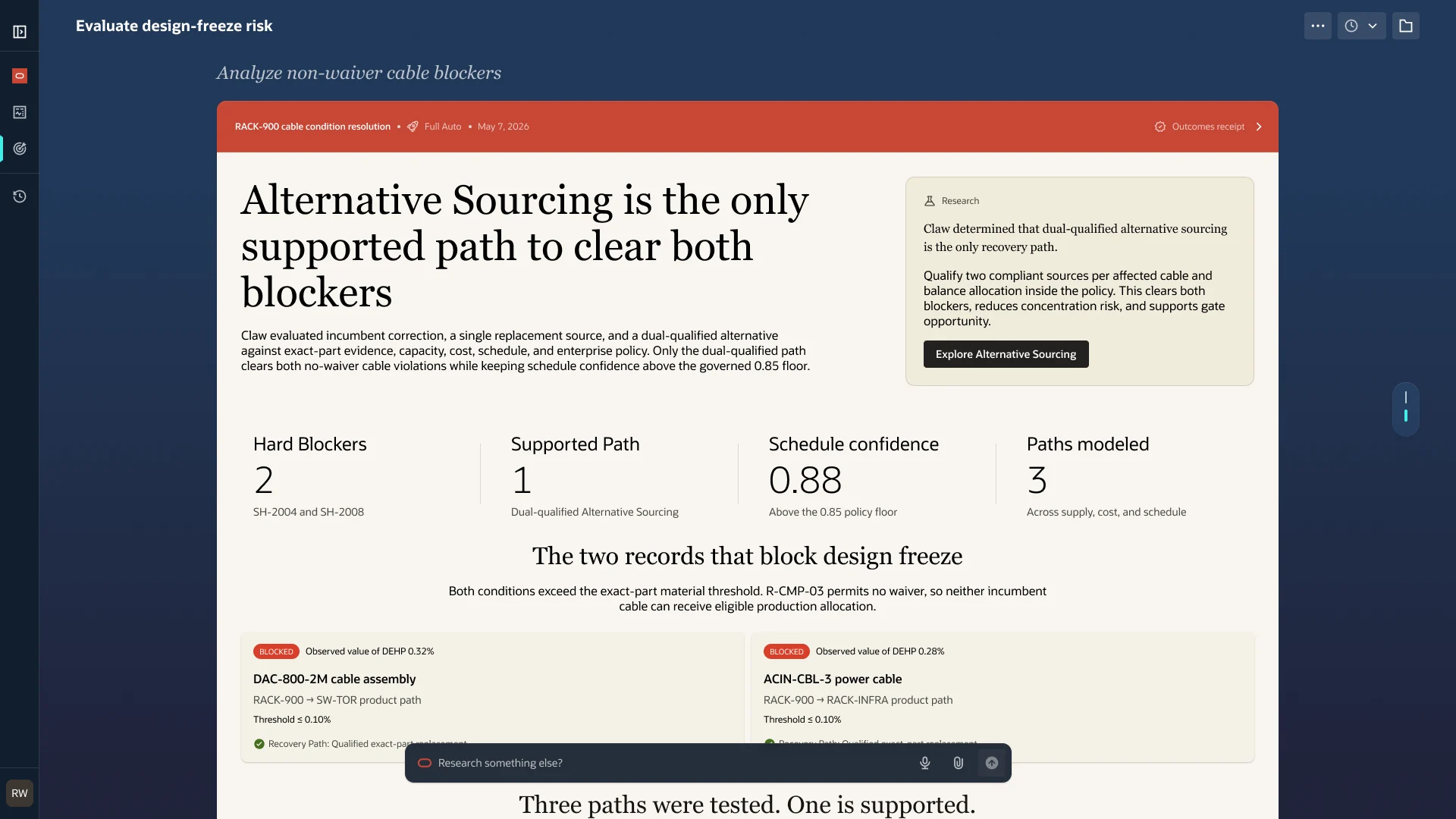
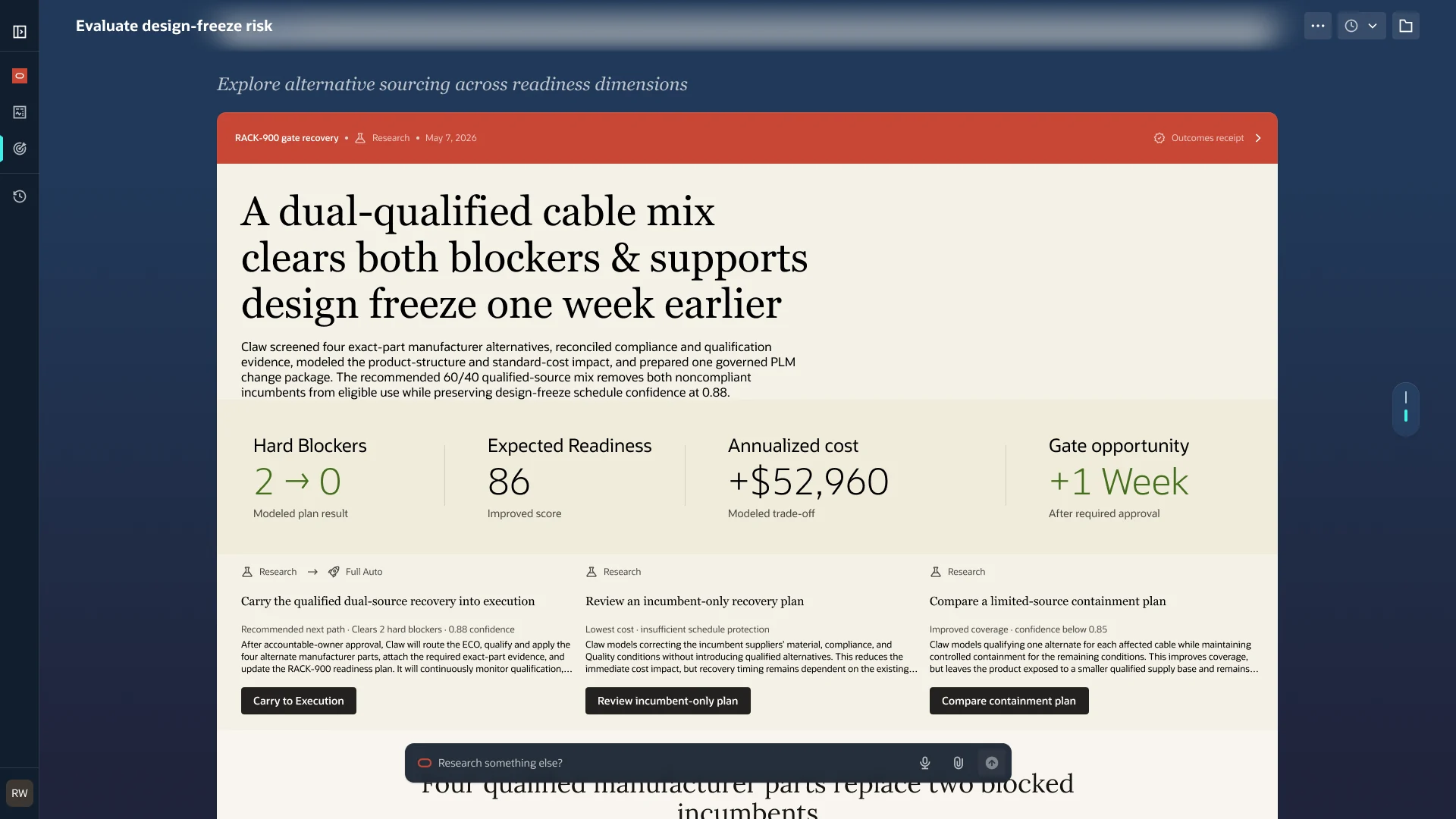
Three recovery paths modeled; alternative sourcing is the only one that clears both blockers. In front, the recommendation: a dual-qualified cable mix, blockers 2 → 0, expected readiness 86, +$52,960 annualised, and the gate a week earlier.
A Red opens onto the actual record, the values, the limit, the rule, and every claim comes with the number a program manager would use to check it.
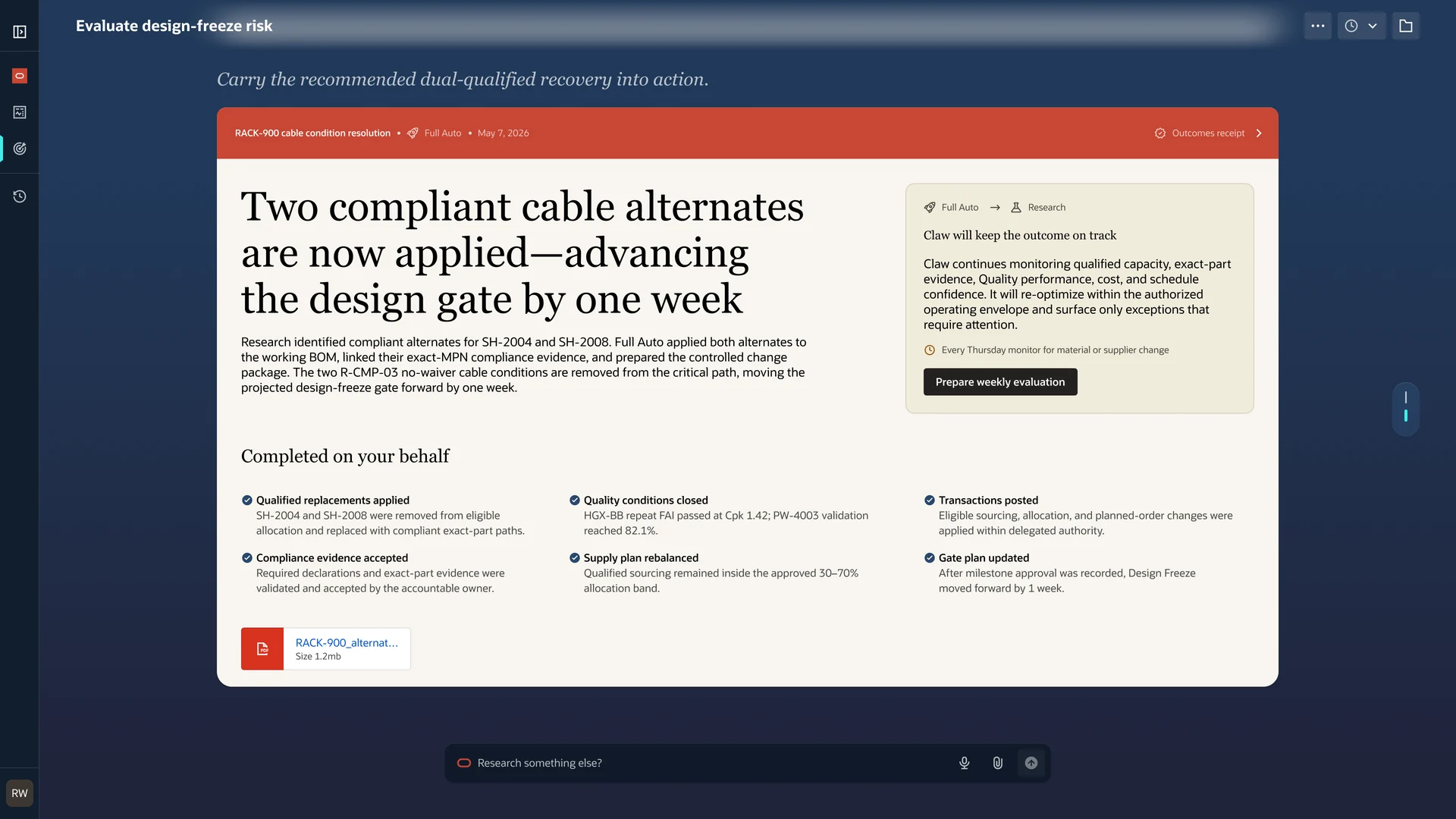
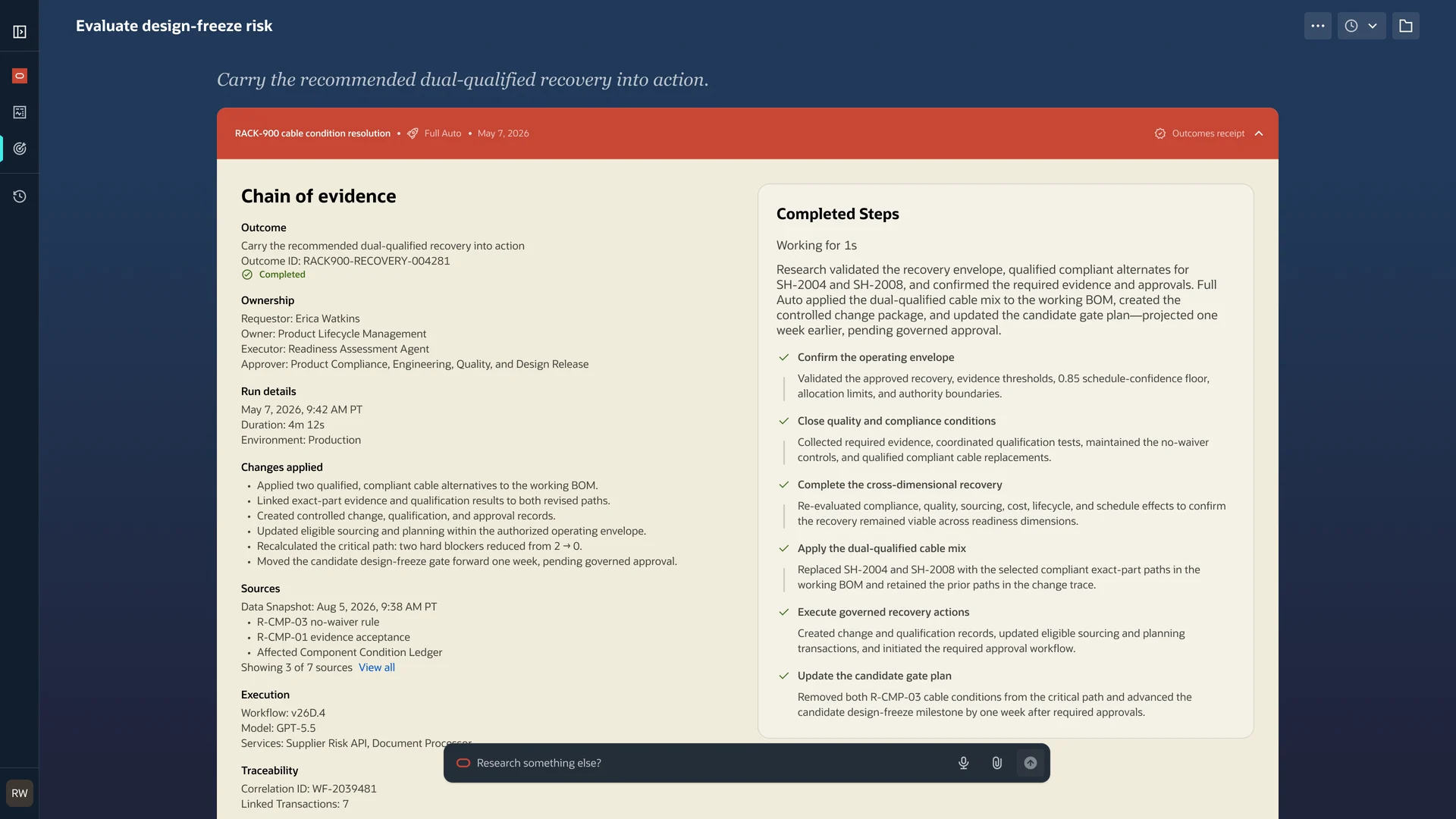
Two compliant alternates applied and the design gate advanced by one week, each change itemized with its approval. Beside it, the chain of evidence for the run: outcome, ownership, changes applied, sources, execution, traceability.
“Completed on your behalf” is the part of the contract people worry about, so it's itemized rather than summarized. The traceability model above, running in the product.
10 · Stakeholders
Seven functions, one gate
11 · Governance
The agent researches everything and approves nothing
12 · How it talks
Four states, and one of them is a refusal
Pattern spec · AGT-02
Conversation
Every reply resolves to one of four states. Which state isn't a style choice; it's decided by what the evidence supports and who owns the decision.
-
01
Evidence supports a claim
Answer
States the claim with its source attached. Asked why, it produces the citation, never a restatement of itself.
Tone: a competent analyst. Nothing phrased to soothe.
-
02
The ask is ambiguous
Repair
Names the ambiguity it hit and offers candidate readings with its analysis: a specific question, not a shrug.
Conversation state survives the repair; work resumes where it stopped.
-
03
Outside its authority
Escalate
Hands off using the decision-rights grid: this finding, this owner, this decision. Never an escalation to “someone.”
Design changes, supplier picks, waivers, gates: humans own all four.
-
04
Against its rules
Refuse
Refuses to average a fatal issue into a passing score, and refuses to decide for the owner. Each refusal names what it won't do, and who can.
A refusal still has to leave the person somewhere useful, which means naming who can answer it.
Fallback rule: degrade honestly. When evidence is missing, the affected dimension surfaces as unassessed with the gap named. A confident guess is the failure mode this system exists to end.
13 · Where it stands
Where it stands
- Live in Fusion as of 2026. RACK-900, 35 descendants, is the reconstructed build I use here to walk it end to end: workspace, verdict, recovery paths, a governed gate package.
- Two records out of thirty-five block the gate, and the readout says so rather than averaging them into a passing score. Most of the design work was protecting that one behavior.
- The autonomy split started on Agentic Fusion Setup, hardened here, and is now a pattern other Oracle teams build against.
- What I want to learn next is how a real gate meeting uses the recovery-path comparison, which is the one part no demo can tell you.