AgileThought · Client: Deloitte · Fintech · 2019
Making usability debt
cost real money.
Users of a legacy tax platform could only tell me it “took too long.” I used KLM-GOMS to turn that feeling into arithmetic, a projected $109M a year, and the client funded a greenfield redesign of the whole Document Management experience on the strength of it.
The short version
- Anecdotes don't get funded. 6 errors a week × 7 minutes × $30/hr × 100,000 accountants ≈ $109M a year does.
- I let the number set the priorities: task automation, shareable views, a version ledger, tagging at upload.
- I tested every two weeks with all three personas, so launch was a non-event.
01 · The problem
The complaint you couldn't put a price on
I inherited a legacy Document Management system that was slow and missing features, and nobody could quantify the pain. Users told me tasks took too long.
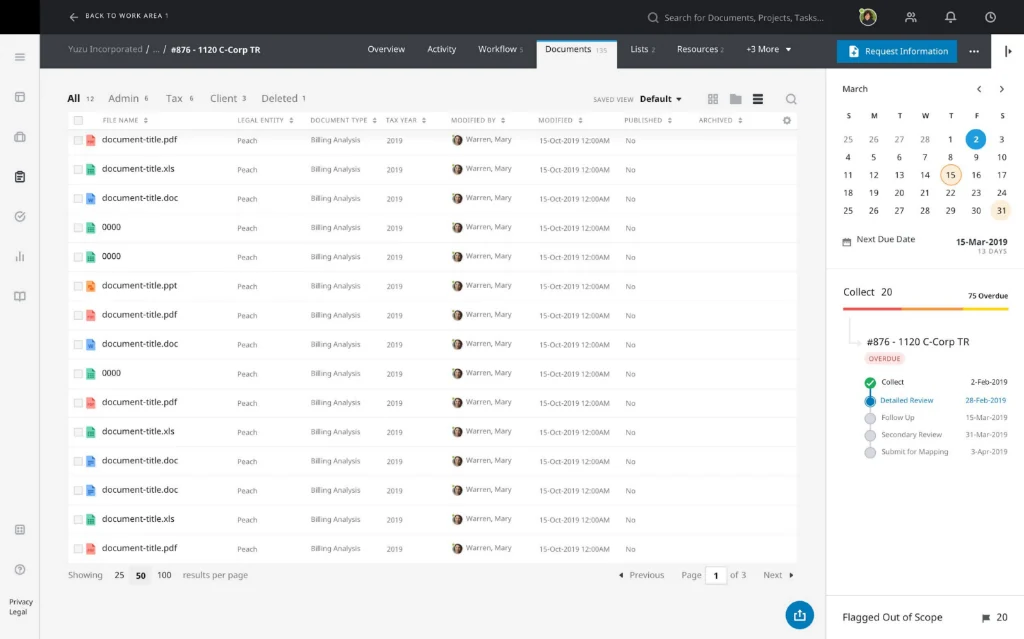
The redesigned Document Management workspace: the document list with its metadata, tax year and legal entity, and the calendar sidebar showing next due dates and workflow status.
Grid, calendar and workflow share one screen, which is the whole point. The old system made those three separate trips.
02 · Who I studied
Three roles, one complaint
03 · The method
Turning a feeling into arithmetic
You don't get a redesign funded off a hallway grievance, so the first job was turning the complaint into something with a number attached. Discovery paired persona and journey work with a System 1 / System 2 read of where the interface was demanding thought it had no right to demand, and KLM-GOMS predicted the task and error-recovery times underneath that. What came out the other end was a defensible nine-figure loss projection. The conversation changed the same week.
04 · The arithmetic
Four numbers the client couldn't argue with
05 · The journey
Where a delegation breaks
06 · The forensics
The research that built the case
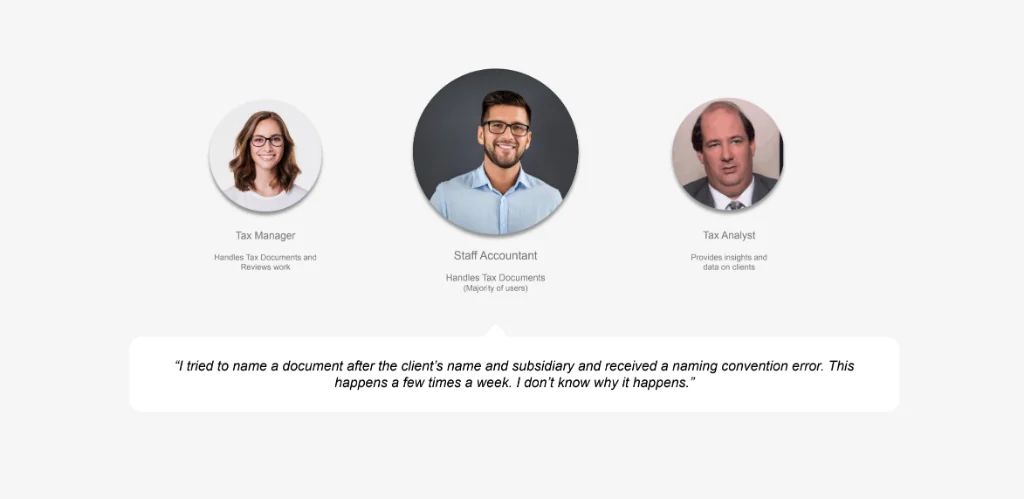
User Personas
Three personas were identified: Tax Manager (handles tax documents and reviews work), Staff Accountant (majority of users, handles tax documents), and Tax Analyst (provides insights and data on clients). Users were international and involved throughout the entire process on a weekly cadence.
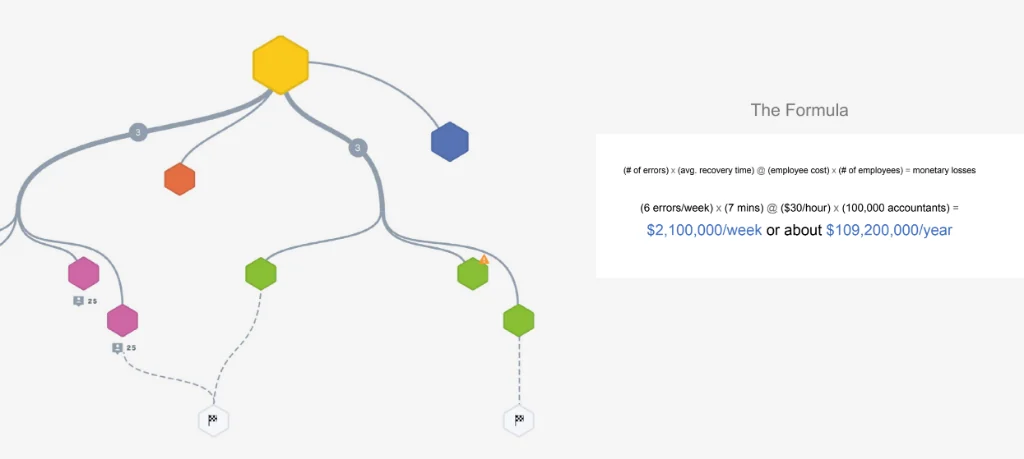
KLM-GOMS & The Formula
Applied the KLM-GOMS HCI method to predict task completion and error recovery time. The formula: (# of errors) × (avg. recovery time) × (employee cost) × (# of employees) = monetary losses. Result: 6 errors/week × 7 mins @ $30/hour × 100,000 accountants = $2,100,000/week or ~$109,200,000/year in losses.
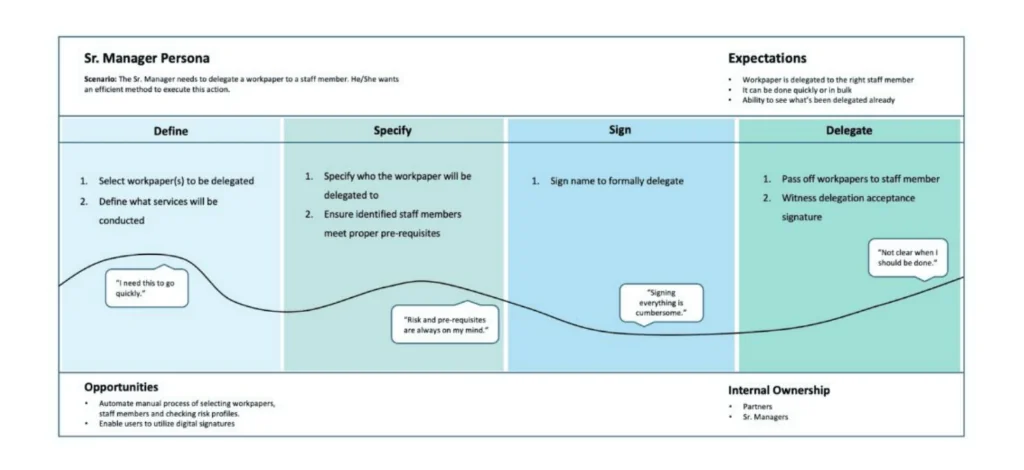
Journey Mapping
A journey map for the Sr. Manager delegation scenario was created, covering Define → Specify → Sign → Delegate stages. Key friction points surfaced: cumbersome signing, ambiguity about completion, and risk-checking overhead. Opportunities identified: automate workpaper selection and enable digital signatures.
(# of errors) × (avg. recovery time) × (employee cost) × (# of employees) = the cost of bad UX.
07 · The redesign
What the number bought
The figure did more than fund the work. It decided the order of it. Each stream went after a cost we had measured. Automation ended the manual hand-off tracking, shared grid views closed the knowledge gaps between roles, a version ledger settled who changed what, and tagging at upload collapsed two steps into one.
08 · The solution
The redesign, screen by screen
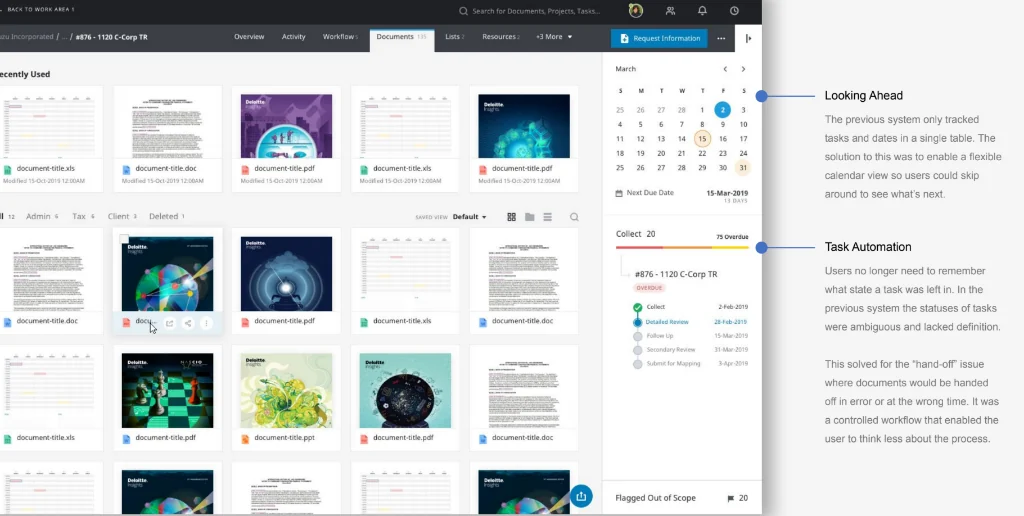
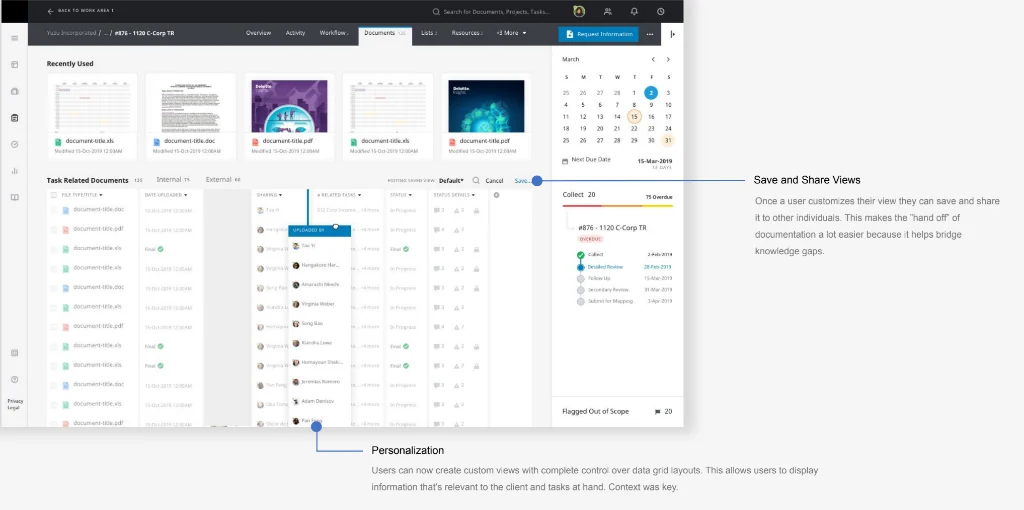
Task management, with the Looking Ahead calendar and task automation states, and in front of it view customisation: a grid with related tasks, sharing and status columns alongside the calendar and workflow panel.
Task states are explicit and automated, so nobody is tracking a hand-off from memory any more. Views save and share, so a colleague inherits your working context instead of rebuilding it.
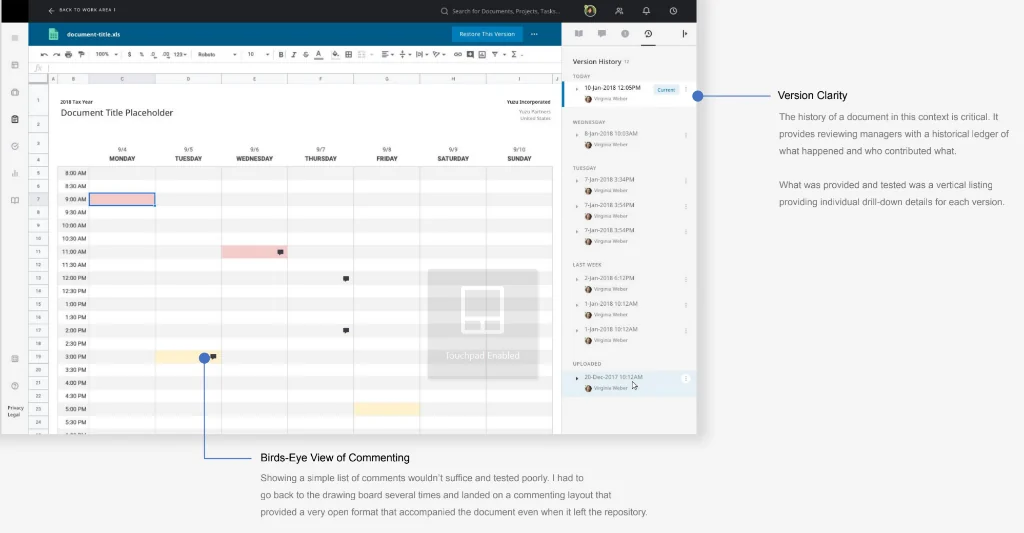
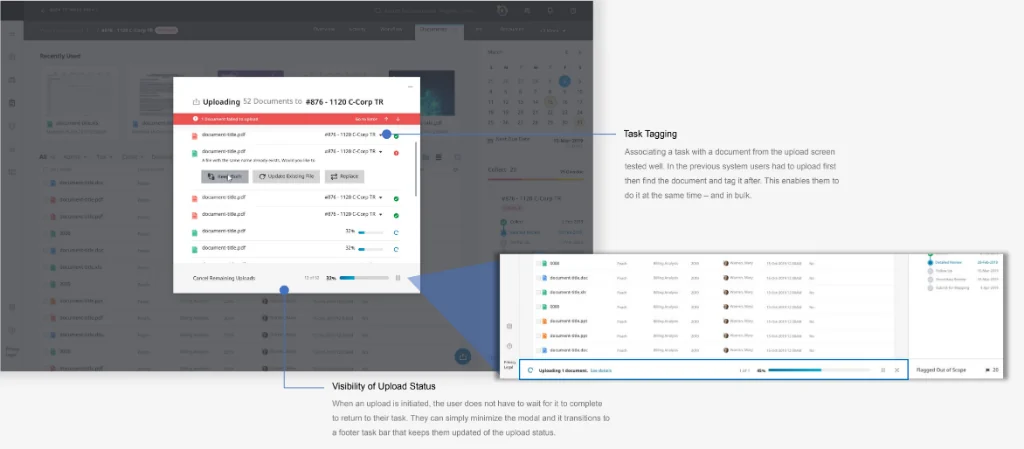
Version history as a vertical ledger with timestamped contributors, beside a birds-eye view of commenting in the spreadsheet itself. Then bulk upload, with duplicate handling, task association, and a footer status bar that can be minimised while you carry on.
Comments travel with the document, even outside the repository. And tagging happens at upload, which retires the old upload-then-go-back-and-tag routine.
09 · Reflections
What I'd carry forward
- My KLM-GOMS analysis priced the usability problems at ~$109M a year. One number set scope, priorities, and budget.
- Task automation ended manual hand-off tracking across all three personas.
- Shareable grid views let people hand over working context instead of rebuilding it.
- I tested biweekly with an international pool, so launch was a non-event: no major issues post-release.