Independent · With the University of Florida · Partner: Google Health · 2008
Your chart, on a disc, fifteen years too early.
MyMedicalSummary took the folder of paper that was your medical history in 2008 and made it portable. Working with the Dean of Medicine at the University of Florida, I designed the pipeline: scan the paperwork, OCR it, sort every page into the right bucket (diagnoses, medications, allergies, labs, imaging), and hand the patient a digitized record they could carry between doctors on disc, or sync to their Google Health profile.
The short version
- The hard part wasn't reading the pages. It was deciding what each page was, automatically, with a QA loop for the ones the algorithm wasn't sure about.
- Uncertain documents went to a human split-screen review, and every accepted match fed the learning algorithm, in 2008.
- Google Health itself retired in 2012 for lack of adoption, which tells you how early this was. The problem it aimed at still isn't fully solved.
01 · The product
Scan, sort, carry
A patient's records arrived as a stack of scans. The pipeline queued them, ran them through a threaded pool of OCR parsers, assigned each item a confidence score, and sorted the confident ones into eleven buckets: diagnoses, medications, allergies and alerts, hospitalization, surgeries, tests and procedures, x-rays and imaging, labs, office and emergency visits, immunizations, correspondence. Anything the algorithm couldn't place went to a human QA screen (the original document on the left, the bucket form on the right), and every accepted match was fed back to improve the matching. The finished profile went home with the patient on disc and, for those who used it, into their Google Health account.
Google Health is the dated part of the story. Google launched it in 2008 as a personal health record and retired it at the start of 2012, citing how few people used it. The bet underneath it (that your record should belong to you and travel with you) was right; the world's incentives weren't there yet. Building against it taught me early what it feels like to design on top of a platform whose fate you don't control.
02 · The system
The pipeline, end to end
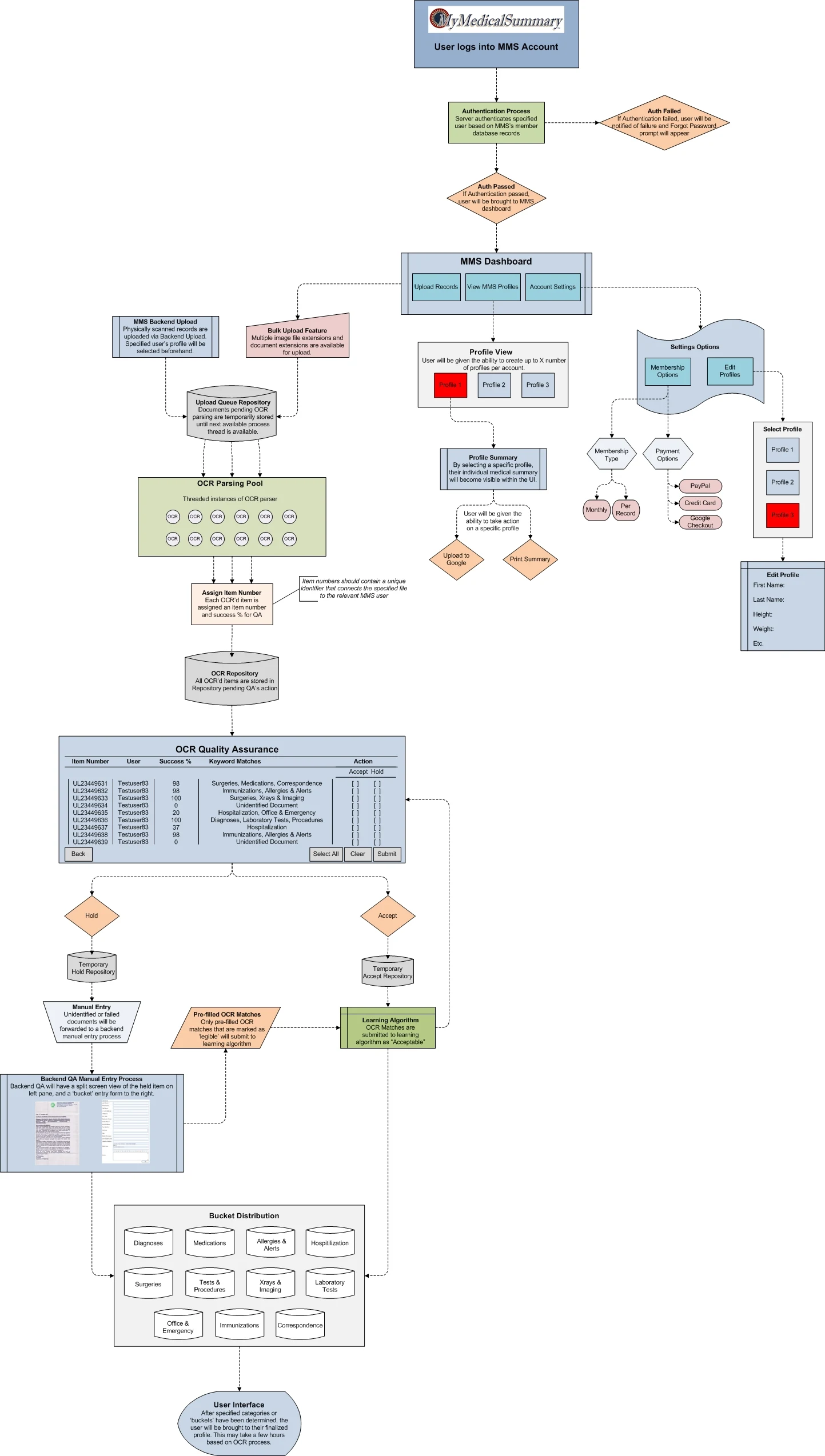
The system design, as drawn in 2008: upload and OCR parsing pool at the top, the quality-assurance grid with per-item confidence in the middle, and the hold/accept fork that routed uncertain documents to manual entry while accepted ones trained the matcher. The buckets at the bottom are the record the patient walked away with.